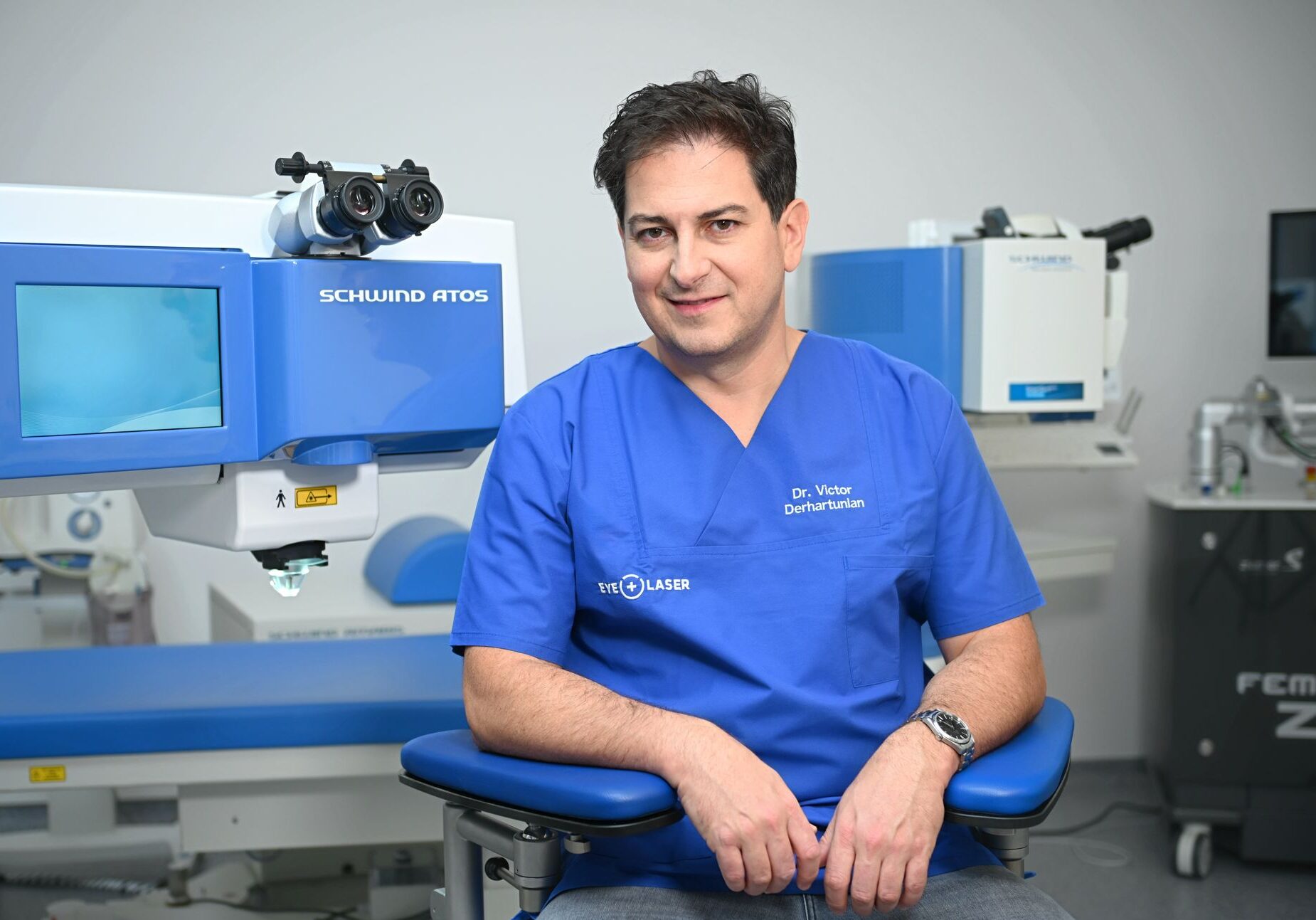
Cataract treatment in Vienna

Specialist practice in Vienna’s city centre, close to St. Stephen’s Cathedral.

We offer modern microsurgical techniques and individually selected premium lenses so that you can enjoy life again with clear, high-contrast, true-colour vision. Many of our patients travel to us from all over Austria and from abroad.

Basics

What is a cataract?

Nahaufnahme eines Auges mit gemusterter Iris

The natural lens of the eye is normally clear and flexible. It focuses light precisely onto the retina.

With age, the protein structures inside the lens change. They clump together, the lens becomes cloudy and light is scattered. The image on the retina blurs.

iBlurred vision: sharpness gradually declines.
iReduced contrast: colours and shades look washed out.
iIncreased glare: light sources radiate more strongly.
Not a disease, but a natural change of ageing. It can only be corrected surgically, by replacing the cloudy lens.

What causes cataracts?

In the vast majority of cases it is simply age: from around 60, almost everyone shows the first signs of lens clouding. There are also factors that speed up the process:

  • Diabetes mellitus: raised blood sugar alters the metabolism of the lens
  • UV radiation over decades without adequate sun protection
  • Smoking
  • Cortisone taken over a longer period
  • Injuries or inflammation of the eye
  • High short-sightedness from about −6 dioptres
  • More rarely congenital or developing in the first years of life

Prevention is limited: sun protection, not smoking and well-controlled blood sugar slow the process down. They cannot stop it.

Symptoms

What are the typical symptoms of a cataract?

Katarakt-Behandlung
iBlurred or milky vision: as if looking through fog or frosted glass.
iColour changes: colours look more yellow or grey.
iIncreased sensitivity to glare: especially when driving at night or in bright sunshine.
iDouble images in one eye: even with the other eye closed.
iHalos around light sources: street lamps and headlights get a ring.

These changes creep in slowly. Many people only notice them once everyday life starts to suffer.

Which types of cataract are there?

Cataracts are classified by where in the lens the clouding sits. That determines which symptoms appear first:

  • Nuclear cataract: the clouding sits in the centre of the lens. It progresses slowly and distance vision fades first. For a while, reading without glasses may even get easier.
  • Cortical cataract: spoke-shaped opacities move from the edge towards the centre. Glare is the leading symptom.
  • Posterior subcapsular cataract: located directly in front of the back of the lens capsule. It progresses fastest and disturbs reading and vision in bright light early on.

The slit-lamp examination shows which type you have. It also influences how urgent the operation is.

When is cataract surgery necessary?

A cataract is not a condition that has to be operated on “in time” to prevent damage. It progresses slowly, and the lens does not suffer if you wait. You decide the timing, not the measurement.

The honest yardstick is your everyday life: when do you start giving up things you would like to do?

Reasons to operate
Night driving becomes unpleasant. Oncoming lights dazzle, street lamps get halos. This is the most common reason patients come to us.
Colours look dull. Many only notice it after the first eye has been operated on: comparing the two eyes, the difference is suddenly obvious.
Glasses no longer help properly. New lenses bring only brief improvement, because it is not the eye changing its power but the lens getting cloudier.
Reading tires you faster, especially in poor light.
When we advise waiting
iIf the clouding does not bother you in daily life. An operation nobody needs is not a good operation, however low the risk.
iIf a retinal or optic nerve condition would limit the result. Then we tell you beforehand what visual acuity is realistic, not afterwards.

Conversely, there is no reason to wait too long: a very advanced, hard lens makes the procedure technically more demanding. The most comfortable moment is when you notice the difference, not when you can hardly see.

The procedure

How is cataract surgery performed?

The most frequently performed operation in the world, and one of the safest in modern medicine.

10 to 20 minutes per eye: as an outpatient and completely painless under anaesthetic eye drops.
Success rate above 97 %: the cloudy lens is replaced by a clear artificial lens.
Microsurgical precision systems of the latest generation, for maximum safety and optimal visual quality.
Check your suitability now: book your no-obligation preliminary examination at our practice in Vienna’s city centre.

The steps of the operation

Preparation

Your eye is numbed with special anaesthetic drops. On request you can also receive a mild sedative (twilight sleep).

Access

A tiny, self-sealing incision at the edge of the cornea creates the access to the lens.

Removal of the cloudy lens

The lens is gently broken up with finely dosed ultrasound energy (phacoemulsification) and aspirated.

Insertion of the artificial lens

A clear, foldable artificial lens is placed into the natural capsular bag. It unfolds immediately and permanently takes over the function of the natural lens.

Prices & services

What does cataract surgery cost in Vienna?

Transparent and binding. One price, every lens, no hidden costs.

FIXED PRICE · EVERY LENS

Cataract surgery including the lens
€3,500 per eye
Monofocal, monofocal-plus, toric, EDOF or multifocal: the price is the same. Which lens goes into your eye is decided by the measurements, not by your budget. From €68 per month.
Included in the fixed price
Care package after the treatment: you take your eye drops for the first days home with you directly from us.
Diagnostics, IOL calculation and lens selection: you pay for the clinical process, not for the lens model
The operation by an experienced specialist, as an outpatient under anaesthetic drops
Structured follow-up checks according to our quality assurance scheme
24/7 emergency availability: you receive the surgeon’s personal mobile number
Tax-deductible in Austria as an extraordinary expense
Cost components of cataract surgery at EyeLaser Vienna, as of 2026.
Service Amount
Free suitability test (15 min.) €0
Cataract surgery including the lens, per eye: any lens type €3,500
Femtosecond laser (FLACS), optional €1,000
iIn a public hospital the Austrian health insurance (ÖGK) covers the operation with a standard monofocal lens, but without free choice of surgeon. With us you are a private patient and pay one all-inclusive price; nothing is added on top of an insurance benefit.

Your recovery

How does healing progress after cataract surgery?

Realistic guide values from practice. Your personal course is closely monitored at the follow-up checks.

Day of surgeryYou go home after about two hours. The eye is sensitive to light; vision is often already clearer than before, but not yet sharp. Do not drive yourself.
Day 1Follow-up check at the clinic. Most people already see well enough for everyday tasks and notice how much more colourful the world has become.
Week 1Do not rub the eye, no heavy lifting, no swimming pool and no sauna. Drops according to the schedule. You take the starter package home with you.
Weeks 2 to 4Visual acuity stabilises. The second eye is operated on now if both are affected. Any glasses that may still be needed are fitted only after that.
Months 2 to 3With multifocal or EDOF lenses, neuroadaptation takes place: the brain learns to use the different focal planes. Rings around lights at night fade into the background.

When can I drive again?

Usually a few days after the procedure, as soon as your visual acuity meets the legal requirements. We confirm this at the follow-up check. Until then: better let someone else drive.

Can a cataract come back?

No. The artificial lens does not cloud over. A cataract cannot develop again. What can occur months to years later is a posterior capsule opacification (“secondary cataract”): a clouding of the remaining lens capsule. It is harmless and is treated painlessly with the YAG laser in a few minutes.

Can a cataract be lasered away?

No, and anyone offering you that means something else. With a cataract, the lens inside the eye is cloudy. A laser that reshapes the cornea does nothing about that: the clouding sits behind it. The only effective treatment is replacing the lens.

There is a reason for the confusion. A laser is indeed used during the operation: the femtosecond laser makes the incision and opens the lens capsule. That is a step within the operation, not a substitute for it. And people who had laser eye surgery before the diagnosis sometimes hear: “You’ll still get a cataract later.” That is true. Laser eye surgery does not prevent it.

The reverse also holds: anyone who has their lens replaced anyway is rid of cataracts for good. An artificial lens cannot become cloudy.

Is there an age limit for cataract surgery?

Not at the upper end. We regularly operate on people well beyond 85, and the oldest eye to receive a new lens with us was 94 years old. What matters is not the year of birth but whether the eye is otherwise healthy and whether you can lie still for twenty minutes.

The procedure is performed under anaesthetic eye drops: no general anaesthesia, no injection behind the eye. That is precisely what makes it well tolerated by the very old and by people with heart or lung conditions. Blood thinners usually do not have to be stopped.

At the lower end, nature sets the limit: a cataract before the age of 50 is rare and then usually has a cause, such as diabetes, prolonged cortisone treatment or an eye injury. In those cases too, we operate as soon as the clouding becomes bothersome.

When we advise waiting
iAs long as you manage in everyday life. A cataract does not become dangerous if you leave it. It only slowly takes away your vision.
As soon as driving, reading or recognising faces suffer, the time has come. Waiting brings no advantage; on the contrary, a very hard, advanced lens is technically more demanding to remove.

Is cataract surgery painful?

No. The eye is numbed with eye drops; you stay awake and responsive. Most patients afterwards describe a feeling of pressure and bright light, nothing more.

In the first hours afterwards the eye may feel dry or gritty. That is normal and usually passes the same day. Painkillers are generally not needed; if they are, an ordinary over-the-counter product is enough.

One note that matters more than the question of pain: severe, increasing pain in the days after surgery is not normal. If that happens, please call us instead of waiting.

How long does cataract surgery take?

The procedure itself takes about fifteen to twenty minutes per eye. What exactly happens is described step by step on Cataract surgery: procedure, lenses and costs. You will be at the practice considerably longer: with preparation, dilation of the pupil and the rest period afterwards, allow around two to three hours.

Timeline of the treatment day, EyeLaser Vienna, as of 2026.
Step Duration
Arrival, final check about 30 minutes
Dilating the pupil 30 to 45 minutes
The operation 15 to 20 minutes
Rest, eye shield, debriefing about 45 minutes
Check-up the next day about 20 minutes

Both eyes are not operated on the same day. There are usually one to two weeks between the procedures, so that the first eye can stabilise and we can feed its result into the calculation for the second.

Why is my vision blurred again weeks after surgery?

If your vision becomes cloudy again after an initially good recovery, often after months, sometimes after years, the cause is almost always a posterior capsule opacification. It is not a relapse and not a sign that something went wrong.

During the operation, the wafer-thin capsule that held your own lens stays in the eye. It holds the artificial lens in place. Over time this capsule can become cloudy. About one in five eyes is affected.

The treatment takes a few minutes and does not hurt. With a YAG laser, a small window is made in the capsule, as an outpatient, without an incision. Afterwards vision is clear again, and the opacification does not return.

If blurring appears in the first weeks, however, it usually has other causes: a dry eye, swelling that has not yet healed, or a glasses prescription that is still settling. That too should be looked at. Please get in touch instead of sitting it out.

How do I recognise a good clinic for cataract surgery?

The operation is considered routine, and it is. There are still differences, just not where most people look for them.

Who measures, and how often? The power of the artificial lens is calculated before the operation. This measurement decides your result more than any device in the operating theatre. Ask how many measurements are taken and whether the surgeon reviews them personally.
Does the person who advises you also operate? In larger institutions this is often not the case. With us it is.
Does the lens recommendation depend on the price? If the trifocal lens costs more than the monofocal one, the advice has a commercial undertone (the individual items are listed on Cataract surgery: procedure, lenses and costs). With us every lens costs €3,500 per eye, so that reason disappears.
What happens if something is not right? Ask who does the follow-up checks and what a touch-up costs. The answer says more about a clinic than any award.

The preliminary examination is the appointment at which all of this can be clarified, even if you decide on another clinic afterwards.

Transparency

Is cataract surgery safe?

Femto-LASIK Behandlung

Cataract surgery is an extremely safe procedure. Complications are rare. We nevertheless talk about them openly.

Common, but temporary
iDryness or mild burning in the first days.
iLight sensitivity or halos around light sources.
iSlight swelling of the cornea: subsides after a few days.
iPosterior capsule opacification: a clouding of the lens capsule, treatable painlessly with the YAG laser.
Premium-Linsen (Phake ICL)
Very rare (below 1 %)
iInfection (endophthalmitis): below 0.05 %.
iSwelling of the central retina (macular oedema).
iRetinal detachment.
iTemporary rise in intraocular pressure.
Your safety net: all procedures are performed under the strictest sterility and quality standards in line with the guidelines of the Austrian Ophthalmological Society (ÖOG).

Premium lenses

Will I see without glasses after the operation?

The operation is also the opportunity to correct existing refractive errors at the same time.

Premium lenses for your individual visual needs

The operation is also an excellent opportunity to correct existing refractive errors.

Comparison: description · advantages
Lens type Description Advantages
Aspheric monofocal lens Sharp vision at one distance (usually far) Maximum contrast sharpness, no light phenomena
Toric lens Corrects astigmatism Sharp distance vision without glasses
EDOF lens (Extended Depth of Focus) Extended depth of field (far + intermediate) Ideal for everyday life and computer work
Multifocal / trifocal lens Vision at far, near and intermediate distance Maximum independence from glasses

All lens types cost the same with us: €3,500 per eye. That is why the measurements alone decide which lens goes into your eye, not the price.

An example from everyday practice: someone expressly wishes for a multifocal or EDOF lens. The diagnostics, however, show an alpha distance of 0.6 mm, the deviation between the optical axis and the centre of the pupil. At this value the eye is not suitable for a multifocal lens, because glare and halos become too likely. In that case we implant a toric monofocal-plus lens instead. This decision costs you not a cent more and not a cent less.

Because no lens model is more expensive than another with us, there is also no commercial incentive to recommend a particular lens to you.

What does cataract surgery give you back in everyday life?

Restore your eyesight with this high-precision treatment and read again entirely without glasses.

Begleitperson nach der Katarakt-Operation
Experiences

What our patients report

“I see every colour clearly again, without glasses! Just two days after the operation I could read the newspaper without glasses.”
— H. M., 68, Lower Austria
“The procedure was completely painless. I was very afraid, but the anaesthetic drops were so gentle that I felt nothing.”
— A. R., 72, Vienna
“A new quality of life with premium lenses. No more changing glasses, no more fog. That is pure freedom!”
— K. S., 65
Dr. Victor Derhartunian
Your advantages

Why EyeLaser Vienna

Located in Vienna’s city centre: close to St. Stephen’s Cathedral, excellent public transport links.
State-of-the-art microsurgical technology of the latest generation.
Outpatient, painless surgery: you go home the same day.
Individually selected premium lenses: matched to your daily life.
Personal aftercare by experienced specialists.
Patients from all over Austria and abroad entrust their eyes to us.
Experience you can measure: the combined cataract and lens surgery experience of the team around Dr. Jirak, Prof. Leydolt and Dr. Kneifl · more than 25,000 laser procedures by Dr. Derhartunian · in Vienna since 2012 · success rate above 97 %.

Frequently asked questions (FAQ) about cataracts

When is the right time for cataract surgery?

The right time has come as soon as the visual impairment noticeably affects your everyday life, for example when reading, driving at night or recognising faces. The rule of thumb: the earlier the operation, the gentler and safer the procedure, because the core of the lens is still softer. Do not wait too long to preserve your quality of life.

How quickly does vision improve after the operation?

Most patients notice a clear brightening and sharpening of their vision as early as the day after surgery. After about a week, vision is usually stable and you can return to your normal activities. Final visual acuity and full adaptation of the eye are usually reached after 4 to 6 weeks.

Is the operation really painless?

Yes. Thanks to modern technology and local anaesthesia, cataract surgery is completely painless. Highly effective anaesthetic eye drops make the eye insensitive to pain for the entire procedure, so you feel no pain. On request, a mild sedative can also be given to ease any nervousness.

How exactly does the operation proceed?

Before the operation: at the preliminary examination we measure your eye completely so that the power of the artificial lens can be calculated exactly. The pupil is dilated with drops for this; afterwards you must not drive yourself for about three hours. It is best to have someone pick you up. If you take medication regularly, please bring a report from your family doctor.

On the day of the procedure have breakfast as usual and take your medication as normal. Please do not use make-up, face cream or perfume.

The anaesthesia is almost always done with eye drops alone. An injection or even general anaesthesia is only needed in exceptional cases.

The procedure itself: after thorough numbing of the eye, a tiny incision of only about 2 to 3 millimetres is made in the cornea. Through this access the cloudy lens is gently removed with finely dosed ultrasound energy (phacoemulsification) and a clear artificial lens is then implanted. The small corneal incision is self-sealing and closes on its own, so no stitches are needed.

The rolled-up artificial lens is inserted through the same small incision and unfolds inside the capsular bag, the natural envelope that previously enclosed your own lens. It stays there permanently, in exactly the place where your own lens used to sit. The procedure takes about 15 to 20 minutes per eye.

What are the risks of cataract surgery?

Cataract surgery is considered one of the safest procedures of all, and serious complications are extremely rare. Normal, temporary mild side effects such as a feeling of dryness, slight itching or increased sensitivity to light usually subside quickly. The risk of a serious infection is below 0.05 % and is minimised by strict hygiene protocols.

What is a posterior capsule opacification (secondary cataract)?

A posterior capsule opacification is not the cataract returning, but a harmless though annoying clouding of the thin capsule into which the artificial lens was placed. It can appear months or even years after the original procedure and causes vision to deteriorate again. Treatment is quick, painless and done as an outpatient with a short YAG laser procedure.

How long does the overall healing take?

The eye heals in several stages, with the first clear improvement in vision usually occurring the day after surgery. After about 1 to 2 weeks the eye is largely stable and most restrictions no longer apply. The final, best possible visual result is achieved after about 4 to 6 weeks, once the eye has fully regenerated.

When can I drive again?

You may only drive again after express clearance from your treating eye specialist. This clearance is given as soon as the visual acuity of the operated eye meets the legal requirements and vision is stable. For most patients this is already possible after a few days.

How long should I take it easy after the operation?

In the first week after the procedure you should strictly avoid physical exertion, lifting heavy loads, swimming, sauna and rubbing the operated eye. Simple activities such as screen work or reading are usually allowed again after 1 to 2 days. Follow your doctor’s instructions exactly to ensure optimal healing.

What does the aftercare look like?

For aftercare you receive a detailed drop schedule with anti-inflammatory and antibiotic eye drops that must be used regularly to prevent infection. The mandatory check-ups with the eye specialist take place the next day, after one week and finally after about one month. These appointments are essential for monitoring the healing process.

Can a cataract be treated without surgery?

No. Successful treatment of a cataract without surgery is currently not possible, because there are no medicines or drops that could reverse the clouding of the lens. The only way to regain clear vision permanently and safely is to replace the cloudy natural lens with a clear artificial lens. So do not wait too long before having the procedure.

The frequently searched term “lasering a cataract” is also medically misleading: a cloudy lens cannot be lasered away like a refractive error on the cornea. When a laser is mentioned in connection with cataracts, it refers to the femtosecond laser. It takes over individual steps of the operation, opening the lens capsule and pre-fragmenting the cloudy lens, and does so more precisely than the hand. In every case, however, the cloudy lens is removed and replaced by an artificial lens.

How long does the new artificial lens last?

A modern intraocular lens lasts a lifetime once implanted and does not need to be replaced. These lenses are made of high-purity, biocompatible material that the body tolerates very well and that neither changes nor clouds over in the eye. After the operation you can rely on permanently clear vision.

Which types of lenses are there?

There are different types of intraocular lenses, which differ in their optical function and are selected individually. They include standard monofocal lenses, toric lenses to correct astigmatism, EDOF lenses for extended depth of field and multifocal lenses (also called trifocal lenses) for sharp vision at far, near and intermediate distances. The choice depends on your personal visual requirements and activities.

Can short-sightedness or long-sightedness be corrected at the same time?

Yes. This is one of the great advantages of cataract surgery: existing refractive errors can be corrected at the same time. Through careful selection and implantation of a suitable premium lens, short-sightedness, long-sightedness, presbyopia and astigmatism can be corrected in one step. This can mean that after the operation you need significantly less or no visual aid at all.

Does health insurance cover the costs?

In a public hospital, yes: cataract surgery with a standard monofocal lens is a benefit of the Austrian statutory health insurance, because a cataract is a condition requiring treatment. There, however, you have no free choice of surgeon. The team on duty operates.

At EyeLaser you are a private patient. You pay an all-inclusive price of €3,500 per eye, which already includes the lens. Nothing is “added on top” of an insurance benefit; that model does not exist in private practice in Austria. As a private specialist service, your insurer reimburses on application 80 % of the respective insurance tariff, not 80 % of our invoice.

What are the total costs with premium lenses?

€3,500 per eye, regardless of the lens type. Whether an aspheric monofocal, a monofocal-plus, a toric, an EDOF or a multifocal lens is implanted makes no difference to the price.

The reason: with us you do not pay for the lens but for the entire clinical process: the diagnostics, the calculation and selection of the lens, the operation and the aftercare. Because the choice of lens does not change the price, it is made purely on medical grounds. The femtosecond laser can be added as an option (€1,000).

Is the operation also possible for older patients?

Yes. Cataract surgery is an extremely gentle and safe procedure that is routinely performed even on very elderly patients over 80 or 90. Because it puts little strain on the body and is done under local anaesthesia, the risk for older people is minimal. The goal is always to preserve independence and quality of life.

Are there alternatives to surgery?

No. For the permanent and effective removal of a cataract there is no treatment alternative to surgery. Neither eye drops nor medication can dissolve the clouding of the lens. Only surgical removal of the cloudy lens and replacement with a clear artificial lens restores clear vision lastingly.

What is the difference between cataract and glaucoma?

A cataract is the clouding of the eye’s lens, which leads to blurred, milky or foggy vision and is usually treated surgically. Glaucoma, by contrast, is a serious condition in which raised intraocular pressure causes progressive damage to the optic nerve, which without treatment can lead to visual field loss. In German the two are called “grauer Star” and “grüner Star”, which is why they are often confused.

When can I do sport again?

Light physical activity such as walking is usually allowed again after one week and supports your well-being. With more intensive sporting activities that put more strain on the body, such as swimming, sauna sessions or any kind of contact sport, you should wait about 4 weeks. Always ask your treating doctor for clearance.

Can cataracts be prevented?

Although complete prevention of cataracts is not possible because of the natural ageing process, you can slow the process down and reduce the risk. Consistent UV protection of the eyes with high-quality sunglasses, not smoking and a balanced diet rich in antioxidants are important. In addition, regular eye examinations from the age of 50 are recommended.

How common are cataracts?

Cataracts are a very common sign of ageing, affecting around 50 % of people over 70 in Austria. Worldwide they are the most frequent and, fortunately, very treatable cause of vision loss in old age. Thanks to the routine procedure, vision can be fully restored in almost all cases.

How long does the whole treatment take?

The entire treatment period, from the first consultation through the actual operation to reaching full visual acuity, is about 4 to 6 weeks. The surgical procedure itself is the shortest part: cataract surgery takes only 10 to 20 minutes per eye and is performed as an outpatient.

4,9 von 5 – über 240 Google-Bewertungen für EyeLaser Wien & Linz