Freedom in everyday Vienna life: Why short-sightedness is a silent brake

Augenlaser
What is myopia (short-sightedness)? The eye is slightly too long in relation to its refractive power. Distant objects are focused in front of the retina and appear blurred; up close, short-sighted people often see excellently.

In Vienna, we live a dynamic mix of business, culture and nature. Short-sightedness is often a constant, underlying burden here:

  • The “disappearing trick” of contact lenses: Anyone who likes to swim in the Alte Donau or Krapfenwaldbad in summer knows the worry of losing expensive lenses or getting an infection from lake water.
  • Winter sports & fogging: Whether skiing at Semmering or entering a warm Viennese coffee house in winter – fogged-up glasses are annoying and often a safety risk.
  • Nocturnal vulnerability: Many patients tell us about a deep-seated anxiety: “What do I do if I wake up at night, there’s a fire, and I can’t find my glasses?”

It’s not enough to simply “laser away the diopters”. We must understand the anatomy of your eye and your lifestyle exactly.

The medical mathematics: Why we set strict limits

Many patients are rejected by other clinics because their cornea is too thin, but often don’t understand why. At EyeLaser Vienna, we explain the physics behind your safety:

Femto-LASIK

1. The micrometer equation (prevention of keratectasia)

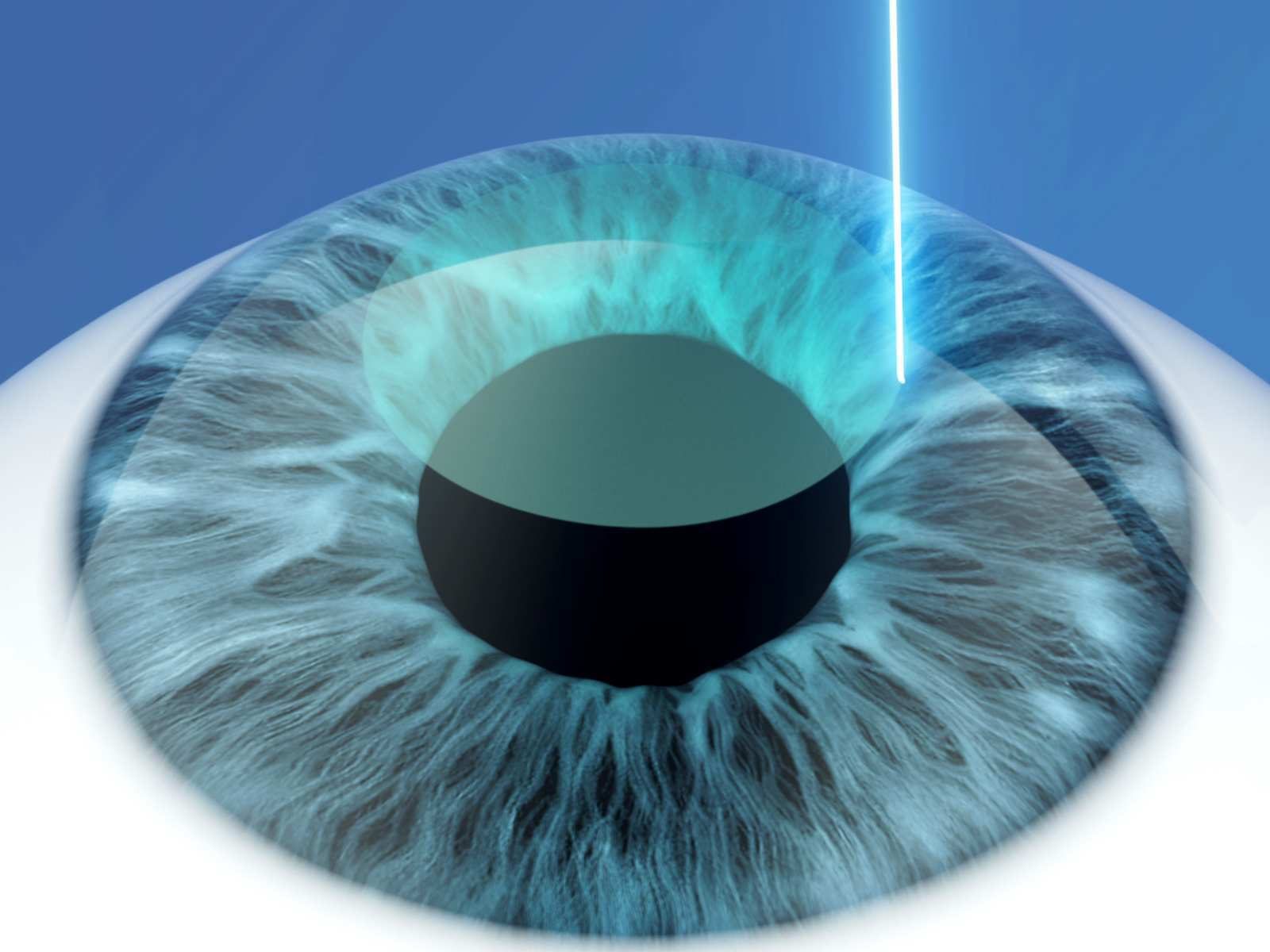
For each diopter of short-sightedness, we need to remove approximately 12 to 15 micrometers of corneal tissue with the laser.
The absolute safety rule of eye surgery states: An intact corneal bed of at least 250 to 300 micrometers must remain beneath the flap. If this limit is undercut, there is a risk of dangerous corneal bulging (keratectasia). If our 3D measurements (Pentacam) show that your tissue is insufficient, we consistently reject laser treatment. We then use so-called “tissue saving” profiles (Schwind Amaris) or immediately switch to plan B (ICL lens implant).

Femto-LASIK

2. The secret of night vision (optical zone vs. scotopic pupil)

Why do some patients suddenly see light rings (halos) at night after a cheap laser operation? The secret lies in the pupil. When it gets dark, your pupil dilates. If the lasered zone (optical zone) is smaller than your dilated pupil at night, light falls into the eye over the unlasered edge. The result is extreme glare effects.
Our standard: We measure your pupil size in absolute darkness (scotopic pupil width) and adjust the laser profile precisely so that the optical zone is always larger than your pupil. For safe night driving.

Short-sightedness from 45: The dilemma of the “built-in magnifying glass”

Phake Linsen (ICL) in Wien

A patient aged 25 and a patient aged 50 may have exactly the same values at -2.0 diopters, but completely different needs. From the age of 45, presbyopia begins – the body’s own lens loses elasticity.

A patient with -2.0 diopters sees poorly in the distance, but can often read perfectly. without glasses. He uses his short-sightedness as a kind of built-in magnifying glass.

The EyeLaser self-test for over-45s:
Take off your glasses now and read something in small print (e.g. on your smartphone). Does that work well? Be aware that this fantastic ability would disappear after a pure laser operation to 0.0 diopters! We’re happy to simulate this effect with you in advance during the consultation.

Ablauf der Katarakt-Operation

Bus driver vs. watchmaker: Individual goals

We adapt the treatment to your profession:

  • The bus driver / pilot: He must recognize signs at a distance with razor-sharp clarity. For him, total correction to 0.0 is ideal (distance dominance). He accepts that he needs reading glasses for reading.
  • The watchmaker / office worker: He works at close range all day. If we lasered him to 0.0, he would be unable to work without reading glasses. Here we recommend deliberate undercorrection (“mini-monovision”) or advise against an operation.
EDOF

The solution: PresbyMAX & monovision

For everyone who wants both, we offer highly developed compromises:

  • PresbyMAX: A special laser profile increases the depth of field of the eye. You gain good distance vision and usable near vision simultaneously.
  • Monovision: One eye is set for distance, the other slightly for near. The brain seamlessly blends the images together.

Which treatment method is right for you?

Comparison: Ideal for · Special feature & technology · Limitations
Method Ideal for Special feature & technology Limitations
SmartSight / LASIK Standard myopia, thick cornea Fast, painless. Proven gold standard. Corneal thickness must be sufficient.
Trans-PRK Athletes, thinner cornea Completely without incision (“no-touch”). Healing takes longer (approx. 4-5 days).
ICL (phakic lens) Very high values, thin cornea Reversible, excellent high-definition optics. Requires sufficient anterior chamber depth (>2.8 mm).
PresbyMAX Patients from 45-50 years Extends depth of field (distance + PC/mobile). Small compromise in contrast vision possible.
Lens exchange (RLE) Patients from 55+ years Replaces your own aging lens. More invasive than a surface laser procedure.

The EyeLaser suitability check: The traffic-light system for your eyes

EDOF-Linsen

🟢 Green Light (Ideal Conditions):

  • Sufficient corneal thickness & regular surface.
  • Age 18–45 (for pure distance correction).
  • Stable values for at least 1 year.
  • Sufficiently deep anterior chamber (for ICL).

🟡 Yellow light (special procedures & medical clarification required):

  • Thin cornea: -> ICL examination (if anterior chamber is deep enough).
  • Age 45+: -> Consultation on PresbyMAX or lens exchange necessary.
  • Large pupils at night: -> Laser profile (optical zone) must be calculated precisely.
  • Dry eyes: -> Prior treatment of tear film absolutely necessary.

🔴 Red light (no operation or medical alternatives):

  • Anterior chamber too shallow: No ICL possible (glaucoma & endothelial risk!).
  • Advanced keratoconus: No refractive laser.
  • Unstable values: The eye is still growing (often in patients under 20).
  • Acute retinal problems: Holes or tears must be lasered by the ophthalmologist beforehand (argon laser).
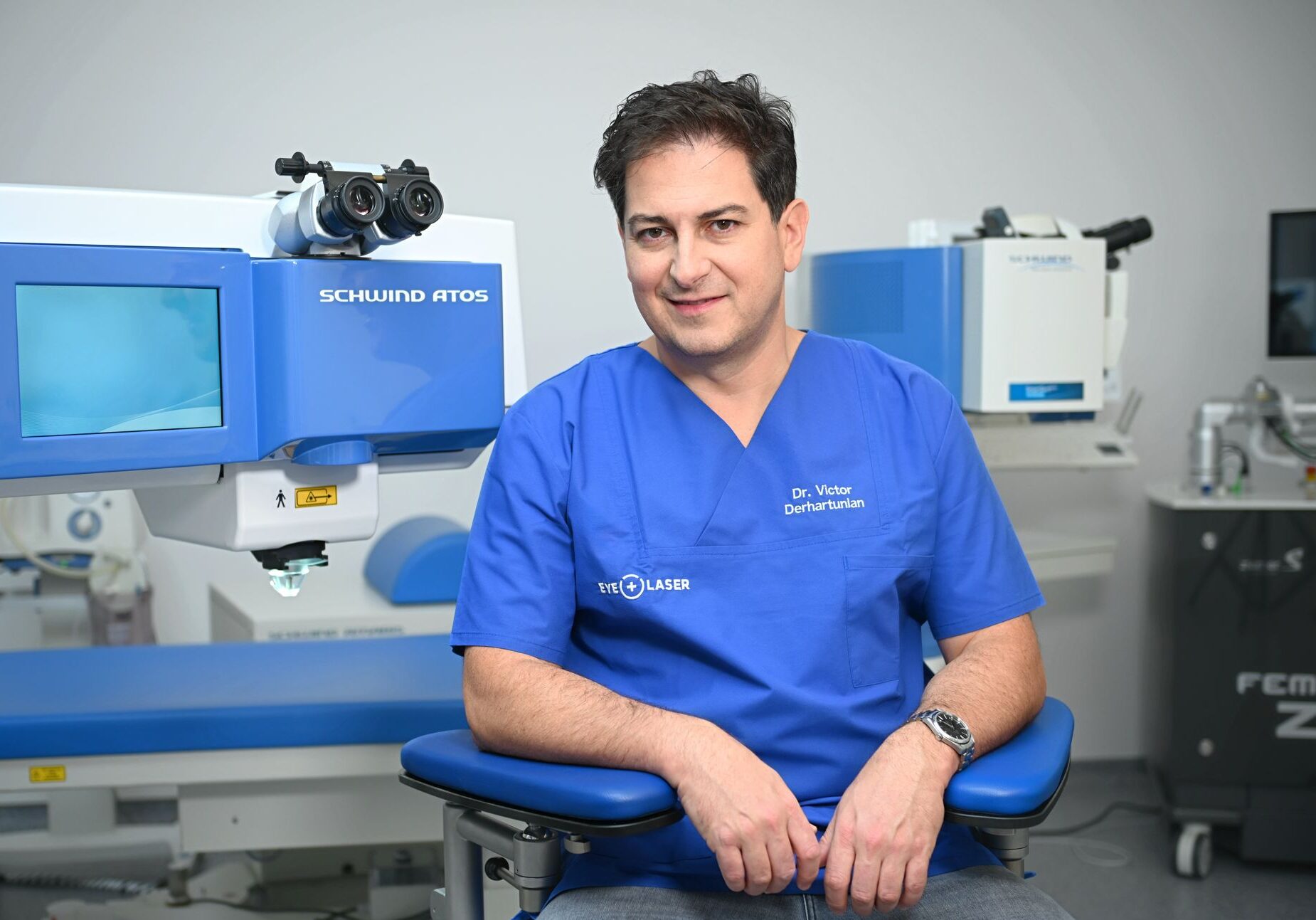
Dr. Victor Derhartunian

“Short-sightedness is more than just a number on your glasses prescription. It determines how safe we feel. My goal at EyeLaser is not just to set diopters to zero. I want to give you the confidence to trust your own eyes in every situation. But we must be honest: Not every eye is suitable. A ‘no’ to surgery is sometimes the most important medical advice I can give.”
– Dr. med. univ. Victor Derhartunian, FEBO

Your path to life without glasses starts today

Don’t leave your eyesight to chance. Invest in the highest Austrian quality standards, the most modern laser and lens technology, and the surgical experience of Dr. Derhartunian.

100% non-binding. No hidden costs. Practice in a prime location in the heart of Vienna.

When we advise against laser surgery: If your prescription has changed within the last year, we do not operate: an unstable myopia would outpace the result. With corneas that are too thin or irregular we also say no to laser treatment; the ICL lens is usually the better and equally precise path. During pregnancy and breastfeeding we always postpone the procedure.
Experience you can measure: Over 25,000 laser procedures performed personally by Dr. Derhartunian · plus the cumulative lens-surgery experience of the team of Dr. Jirak, Prof. Leydolt and Dr. Kneifl · in Vienna since 2012 · success rate above 97%.
Book your suitability check in Vienna online in 15 minutes now

Frequently asked questions (FAQ) about short-sightedness in Vienna

What exactly is short-sightedness (myopia)?

In short-sightedness, the eyeball has grown too long. As a result, the incoming light is not focused exactly on the retina, but in front of it. The result: Distance is blurred, near vision is usually good.

I was rejected elsewhere because my cornea is too thin. Do you have a solution?

Very often, yes. If the cornea is too thin for the excimer laser, the ICL (implantable contact lens) is the ideal “plan B”. It leaves the cornea intact. However, the prerequisite is that your eye’s anterior chamber is anatomically deep enough (at least 2.8 mm).

What happens if neither laser nor ICL is possible?

If the cornea is too thin AND the anterior chamber is too shallow, we advise against an operation on the healthy eye. The risk to internal eye structures (endothelial cell loss, risk of glaucoma) would be too high.

Should I be worried about my retina with high short-sightedness?

Yes, regardless of the operation. A highly short-sighted eye (myopia magna) is “longer” than normal, which puts the retina under tension. The risk of retinal holes is statistically increased. Important: A laser operation does not change this risk – it remains. That’s why at EyeLaser we perform a retinal examination with dilated pupils before every procedure.

Can short-sightedness come back after laser treatment (regression)?

The removed tissue does not grow back. However, in rare cases (approx. 1-5%), especially with high values, slight regression can occur because the cornea reacts biomechanically. Usually these are low values (e.g. -0.5 diopters). Here we can often perform a straightforward enhancement.

Does laser eye surgery hurt?

The procedure itself is painless because the eye is anesthetized with drops. After the procedure: With LASIK/SmartSight you have a foreign body sensation for about 4-6 hours. With Trans-PRK, the first 2-3 days are often uncomfortable and light-sensitive.

What happens if I blink or cough during the operation?

A fine lid speculum keeps the eye open. The laser has a 7D eye tracker that tracks your eye over 1,000 times per second. If you cough or twitch, the laser stops in milliseconds. Nothing can be “lasered incorrectly”.

Can I go blind from the operation?

Blindness from a laser operation is practically non-existent in modern medical practice. Since we work on the surface (cornea), the optic nerve and retina remain completely untouched. We minimize the theoretical risk of infection through the highest surgical hygiene standards.

When can I return to work?

After LASIK, SmartSight or an ICL implantation, often after just 24-48 hours. With Trans-PRK, please plan for 4-5 days off work, as the epithelium must first regrow.

How long do I have to avoid sports?

Jogging/fitness: After 2-3 days. Swimming (Alte Donau, indoor pool): Strict break of 2 to 3 weeks due to risk of infection (acanthamoeba). Combat sports: Here we strongly recommend flap-free methods (Trans-PRK, SmartSight, ICL).

Can I drive after the operation?

Not on the day of the operation. The day after the operation you come for a check-up. Usually patients already achieve the legally required visual acuity here. As soon as the doctor gives the “OK”, you can drive again.

I am pregnant or breastfeeding. Can I have laser treatment?

No. Hormonal changes can make the cornea thicker (water retention) and falsify the diopters. Please wait with the preliminary examination until about 3 months after weaning.

Why am I not allowed to wear contact lenses before the examination?

Contact lenses slightly deform the cornea (warpage effect). So that we can measure with micrometer precision, soft lenses must be left out for 1 to 2 weeks and hard lenses for 2 to 4 weeks before the measurement.

Does the Austrian Health Insurance Fund (ÖGK) cover the procedure?

Usually not (lifestyle procedure). Exception: In cases of extreme anisometropia (see question 15) or proven, absolute intolerance of glasses AND lenses, a subsidy can be granted in very rare individual cases. Otherwise, you can deduct the operation from your taxes.

What is anisometropia and can EyeLaser help here?

Anisometropia means that one eye is, for example, severely short-sighted (-6 dpt) and the other is normal (0 dpt). Glasses lead to differently sized images in the brain (aniseikonia) and cause dizziness. A laser operation or ICL is often the only medically sensible solution for perfect 3D vision.

Is there installment payment at EyeLaser Vienna?

Yes. We work with reputable financing partners who enable convenient installment payments.

How long does the actual laser procedure take?

The pure use of the laser for short-sightedness usually takes only 10 to 15 seconds per eye.

Is my vision immediately perfect the day after the procedure?

With femto-LASIK and SmartSight, visual acuity is often already at 90 to 100% the next day. Nevertheless, the brain needs time to adapt to the new vision (neuroadaptation).

How high is the risk of dry eyes?

A temporary feeling of dryness is normal. We use tissue-sparing methods (such as SmartSight without a large flap incision) to protect the corneal nerves, which massively reduces the risk of chronically dry eyes.

Up to what age can short-sightedness be lasered?

There is no upper age limit, provided there is no lens opacity (cataract). From about 50-55 years, however, we carefully check whether a refractive lens exchange is the better long-term investment than the corneal laser.

What is the difference between ICL and lens exchange (RLE)?

With ICL (for patients under 45), an additional artificial lens is implanted, the natural lens remains. With lens exchange (from 50 years), your own aging lens is removed and replaced with a premium multifocal lens.

Can I wear makeup after the operation?

To minimize the risk of infection, we recommend avoiding eye makeup for at least one week and not rubbing your eye when removing makeup.

Can short-sightedness and astigmatism be lasered at the same time?

Yes, that is the absolute standard. The excimer laser reshapes the cornea so that both visual defects are corrected in the same 15 seconds.

Can my child (e.g. 16 years old) already have laser treatment?

No. We only laser from 18 years. The most important factor: The diopter values must have been absolutely stable for at least one year. If the eye is still growing, the short-sightedness would return after the operation.

My child is becoming increasingly short-sighted. Do you offer myopia control?

The progression of short-sightedness in childhood is a serious issue (myopia progression). A laser procedure is not possible here, but there are special eye drops (low-dose atropine) or special contact lenses/spectacle lenses that can slow the lengthening growth of the eye. Talk to your pediatric ophthalmologist about this.

Why does the preliminary examination take almost two hours?

Premium safety takes time. We dilate your eyes (to measure the exact refractive power with the ciliary muscle paralyzed), scan the retina for weak spots, check the anterior chamber depth, the night pupil, and take time for honest medical consultation.

4,9 von 5 – über 240 Google-Bewertungen für EyeLaser Wien & Linz