What is astigmatism?

Astigmatism, astigmatism, astigmatism, “dotlessness”: all these words describe the same phenomenon. In an eye with normal vision, the cornea is shaped in such a way that incoming rays of light are bundled in such a way that they are directed to the focal point. is created. This produces a sharp image.

However, if the cornea is curved, there are different radii of curvature and different refractive powerin the two main axes of the cornea andthe light is not focused on the focal point, but instead several focal points or visual axesare created, causing blurred vision and can lead to headaches or burning eyes.

Various forms of astigmatism:

In practice, the distinction between regular astigmatism and irregular astigmatism is particularly relevant – which form of astigmatism is present and to what extent has an influence on the treatment options:

  • Regular astigmatism: The light rays are imaged on vertical focal lines.
  • Irregular astigmatism: The focal lines are irregularly arranged or the refractive power is different at different points.

In most cases, regular astigmatism can be treated with a laser. Irregular astigmatism is therefore more difficult to treat, as the incident light is directed in different directions to different places away from the focal line.

Astigmatism compositus occurs when myopia and / or hyperopia are present in addition to astigmatism.

Today, it is regularly possible to correct all visual defects with just one procedure.

Recognize astigmatism symptoms in good time – operate on astigmatism

Patientin bei der Untersuchung auf Keratokonus.
What is astigmatism? The cornea is not evenly round but curved more strongly in one direction, similar to a rugby ball. Light rays are therefore not focused in a single point: contours appear distorted or doubled, near and far alike.

Most adults who are interested in laser eye surgery already know that they have a congenital astigmatism and therefore wear glasses or contact lenses.

Self-diagnosis is not reliably possible, which is why a visit to the ophthalmologist is essential. However, there are symptoms that may indicate that you are suffering from astigmatism:

  • Distorted or blurred vision
  • Double images
  • Headache
  • Eye pain due to cramped muscles
  • Dizziness
  • Coordination difficulties

Suitability test & preliminary examination at EyeLaser Vienna & Linz

The dream of a life without glasses, contact lenses and defective vision: many people dream it and millions have made it come true. With your free and non-binding aptitude test in Vienna or Linz to find out whether astigmatism correction is possible.

A holistic preliminary examination offers an in-depth analysis. All important diagnostic measures are carried out in 90 minutes, you are informed, advised and can ask your questions.

Aptitude test
0 €

Is it possible to correct astigmatism?

Preliminary examination
200€*

What is your optimal treatment plan?

* The costs of the preliminary examination are fully offset against the treatment costs.

Laser treatment of astigmatism & correction of all visual defects

Astigmatism, astigmatism and other visual defects often occur in combination. At EyeLaser Vienna, we carry out 5 different procedures for refractive vision correction, which can permanently eliminate all other visual problems in addition to astigmatism in a single operation:

The table below shows which refractive errors can be corrected with Femto-LASIK, Trans-PRK, SmartSight, ICL and lens replacement.

Femto-LASIKTrans-PRKSmartSightICLLens replacement
Astigmatism+++++
Myopia +++++
Farsightedness ++-++
Presbyopia +/-+/-+/-+/-+
Cataract ----+

Find out what astigmatism is and how we treat it

Eliminate your astigmatism and enjoy a life without glasses and contact lenses.

Laser astigmatism – procedure at a glance

Astigmatism surgery with Trans-PRK 7D

A tried and tested procedure without touching and without a flap. Transepithelial photorefractive keratectomy (Trans-PRK for short) does not require a corneal incision and is therefore particularly gentle on the tissue.

Without a corneal incision and is therefore particularly gentle on the tissue.

An excimer laser ablates the surface of the cornea and shapes the corneal tissue in such a way that the light is focused precisely on the focal point and the visual defect(s) are corrected.

Advantages of astigmatism correction with Trans-PRK:

  • Can be performed without corneal incision and contact
  • High corneal stability is maintained
  • Treatment of superficial corneal opacities
  • Tissue-friendly procedure
  • Also possible for thin corneas & dry eyes

Requirements for a Trans-PRK:

  • Short-sightedness: -8 diopters
  • Farsightedness: +3 diopters
  • Corneal curvature: 6 diopters
Femto-LASIK 7D - also for astigmatism lasering

Since 1991, more than 50 million people have had their visual defects corrected with LASIK. Laser in situ keratomileusis means “changing the shape inside the cornea”. The cornea is cut with a high-precision femtosecond laser so that the top layer can be folded back (flap).

The corneal curvature and all other visual defects can then be corrected using the excimer laser. The flap is then “folded back” and heals completely.

Advantages of Femto-LASIK 7D:

  • Extremely precise corneal flap
  • Gentle removal of the cornea
  • Precise and individual modeling of the cornea
  • Rapid visual recovery after the procedure
  • Uninterrupted blood flow to the retina
  • See clearly the very next day

Requirements for Femto-LASIK 7D:

  • Short-sightedness: up to -10 diopters
  • Farsightedness: up to +4 diopters
  • Astigmatism: up to 6 diopters
  • Corneal thickness: at least 480 micrometers
SmartSight lenticular extraction for astigmatism

The innovative procedure with the SCHWIND ATOS laser requires only a single, tiny incision (2-3 mm). The femtosecond laser forms a lenticule on the cornea, which is then removed through the incision. The lenticule is shaped in such a way that the cornea is modeled in such a way that it then correctly refracts incoming light rays.

The most popular variants of lenticel extraction are: ReLEx SMILE (Pro), Clear and SmartSight. At EyeLaser Vienna, Linz and Zurich, we rely on SmartSight.

Advantages of SmartSight:

  • Can also be used for more pronounced astigmatism
  • Gentle on tissue due to lenticular geometry
  • Extremely fast healing and high safety
  • State-of-the-art laser technology (eye tracking, cyclotorsion compensation, etc.)
  • No flap, no cut & no surface abrasion
  • Can be individually adapted to the patient’s visual defect

Requirements for lenticel extraction:

  • Short-sightedness: up to -10 diopters
  • Astigmatism: up to – 6 diopters

If farsightedness is present and needs to be corrected, SmartSight is not yet an option. This is because it cannot be corrected in the course of lenticule extraction. In this case, it is better to use one of the four other procedures.

Lens surgery instead of laser eye surgery, spectacle lenses and contact lenses

In addition to the possibility of having astigmatism corrected by laser, there is lens surgery, which takes a fundamentally different approach to correction. No laser is used (apart from the Femto lens exchange).

The problem is solved by adding a toric artificial lens or replacing the natural lens with toric artificial lenses.

Lens implantation – ICL Phake lenses

If laser eye surgery is not possible or the astigmatism is too pronounced, ICL lens implantation is an option, especially for younger patients. The natural lens remains in the eye and is supplemented by an artificial lens that is inserted in front of or behind the natural lens.

The toric ICL Phake lens (EVO/EVO+ VISIAN ICL), which is specially made for astigmatism, optimally compensates for refraction and, together with the crystalline lens, ensures that the visual defect(s) are corrected.

Advantages of lens implantation:

  • Thinner and deformed corneas (including keratoconus) are not a problem
  • Correction of very severe visual defects possible
  • Replaceable in case of changes in visual acuity
  • Integrated UV protection for the eyes
  • Also suitable for dry eyes and / or contact lens intolerance
  • Individually adapted to the patient’s exact visual defects

Requirements for an ICL Phake lens:

  • Short-sightedness: up to -23 diopters
  • Farsightedness: up to +10 diopters
  • Astigmatism: up to 10 diopters
Refractive lens exchange - Toric artificial lenses

The natural lens is completely removed and replaced by a toric artificial lens. This procedure is particularly suitable for older people (aged 55 and over), as presbyopia can be corrected and cataracts can be cured or prevented.

Patients can choose between two types of artificial lenses – both available as toric and non-toric versions – for people without astigmatism.

  1. Toric monofocal lenses: Only one focal point, so that after the procedure you can only see sharply at near or far distances.
  2. Toric multifocal lenses / EDOF: Multiple focal points for sharp vision over all distances without glasses. EDOF = with extended depth of field for a smooth transition and even more natural vision.

If the indication for lens replacement is not vision correction, it is referred to as cataract surgery. The procedure, costs and result do not differ.

Advantages of lens replacement:

  • Precise correction of astigmatism possible without laser
  • In addition to “normal visual defects”, presbyopia & cataracts can also be treated
  • Complete and permanent healing of cataracts
  • Development of corneal opacity is prevented forever
  • With multifocal lenses, glasses and contact lenses can be dispensed with

Requirements for lens replacement or cataract surgery:

  • Short-sightedness: from -6 diopters
  • Farsightedness: from +4 diopters
  • Astigmatism: up to 6 diopters

If you have a diseased or scarred cornea or retinal disease, it may not be possible to replace the lens.

Behandlung von Myopie in der Klinik
Trans-PRK 7D
1.700 €
  • Price per eye
  • from 33 euros / month*
  • 283 € / month over 6 months


* Loan term: 5 years. Effective annual interest rate: 6.6 percent.

Femto-Lasik 7D
1.950 €
  • Price per eye
  • from 33 euros / month*
  • 283 € / month over 6 months


* Loan term: 5 years. Effective annual interest rate: 6.6 percent.

SmartSight (lenticular extraction)
2500 €
  • Price per eye
  • ab 48 Euro / Monat*
  • 416 € / month over 6 months


* Loan term: 5 years. Effective annual interest rate: 6.6 percent.

Lens implantation
3500 €
  • Price per eye
  • from 68 euros / month*
  • 583 € / month over 6 months


* Loan term: 5 years. Effective annual interest rate: 6.6 percent.

Trans-PRK 7D
1.700 €
  • Price per eye
  • from 33 euros / month*
  • 283 € / month over 6 months


* Loan term: 5 years. Effective annual interest rate: 6.6 percent.

Femto-Lasik 7D
1.950 €
  • Price per eye
  • from 33 euros / month*
  • 283 € / month over 6 months


* Loan term: 5 years. Effective annual interest rate: 6.6 percent.

SmartSight (lenticular extraction)
2500 €
  • Price per eye
  • ab 48 Euro / Monat*
  • 416 € / month over 6 months


* Loan term: 5 years. Effective annual interest rate: 6.6 percent.

Lens implantation
3500 €
  • Price per eye
  • from 68 euros / month*
  • 583 € / month over 6 months


* Loan term: 5 years. Effective annual interest rate: 6.6 percent.

Lifestyle lens exchange (cataract surgery)
3.500 €
  • Price per eye
  • from 68 euros / month*
  • 583 € / month over 6 months


* Loan term: 5 years. Effective annual interest rate: 6.6 percent.

Standard lens exchange (cataract surgery)
3.500 €
  • Price per eye
  • ab 48 Euro / Monat*
  • 416 € / month over 6 months


* Loan term: 5 years. Effective annual interest rate: 6.6 percent.

Femtosecond laser surcharge
1.000 €
  • Price per eye
  • ab 29 Euro / Monat*
  • 150 € / month over 6 months


* Loan term: 5 years. Effective annual interest rate: 6.6 percent.

Lifestyle lens exchange (cataract surgery)
3.500 €
  • Price per eye
  • from 68 euros / month*
  • 583 € / month over 6 months


* Loan term: 5 years. Effective annual interest rate: 6.6 percent.

Standard lens exchange (cataract surgery)
3.500 €
  • Price per eye
  • ab 48 Euro / Monat*
  • 416 € / month over 6 months


* Loan term: 5 years. Effective annual interest rate: 6.6 percent.

Femtosecond laser surcharge
1.000 €
  • Price per eye
  • ab 29 Euro / Monat*
  • 150 € / month over 6 months


* Loan term: 5 years. Effective annual interest rate: 6.6 percent.

Customized vision correction: laser correction of astigmatism

Take the step into a life in which astigmatism is no longer an issue. No more glasses to wear, no more contact lenses to insert. Simply be free and be able to marvel at and enjoy the finer things in life at any time.

That is the promise we would like to make to you at EyeLaser Vienna and Linz. Independence and freedom create a valuable quality of life. Regardless of age, gender and visual defect:

We have the right vision correction for you.

Aptitude test
0 €

Is it possible to correct astigmatism?

Preliminary examination
200€*

What is your optimal treatment plan?

* The costs of the preliminary examination are fully offset against the treatment costs.

Astigmatism in children: What to do

Frau bei Augenuntersuchung

For children in particular, it is important that a suspicion of astigmatism is recognized and clarified as early as possible. As parents, you should pay particular attention to the following symptoms:

  • Disturbance of hand-eye coordination (“reaching next to”)
  • Noticeable frequent falling or swaying (dizziness)
  • Complaints about distorted or blurred vision
  • Headaches and eye pain

If astigmatism is not recognized and treated for too long, there is a risk of permanent visual impairment (amblyopia) and a more pronounced deformation. In contrast, the Occlusion therapy help:

The stronger eye is covered with a plaster so that the brain is forced to concentrate on processing the impressions of the weaker eye. The earlier occlusion therapy and / or glasses are used to counteract this, the better the chances of a complete cure or recovery from the visual impairment.

Our tip: Go for an eye examination at regular intervals – especially if there are signs of defective vision or eye disease.

Can astigmatism disappear on its own?

Theoretically, this is possible. In rare cases, a curvature of the cornea normalizes on its own. However, if it is so pronounced that it is noticeable in everyday life, it is unlikely that it will reduce to such an extent that you can see “normally” again (without glasses or contact lenses).

Astigmatism corrected in 3 steps:

1. corneal curvature diagnosis:

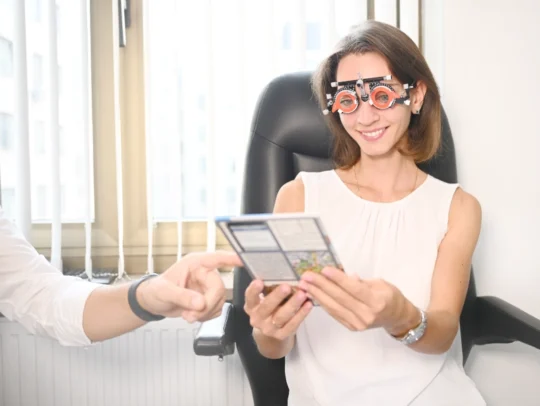
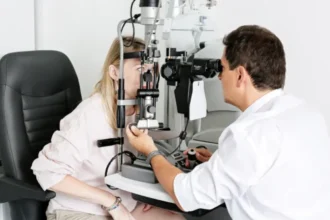
Before the optimum treatment for you can be selected, a comprehensive preliminary examination is carried out. The results lay the foundation for your independence from visual aids. Among other things, we carry out the following examinations to determine the type and severity of the astigmatism:

  • Objective refraction:

Measurement of the sharpness of a projected image using different lenses.

  • Subjective refraction:

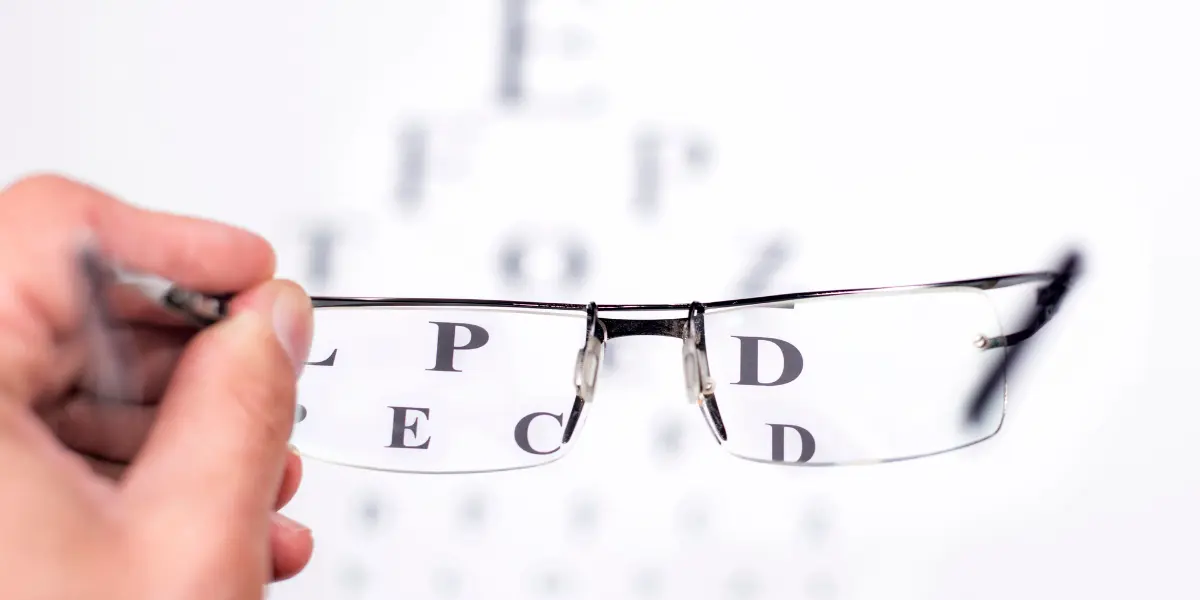
Selection of a lens with which the patient has the impression of seeing the eye chart clearly.

  • Corneal topography:

Especially for irregular astigmatism to determine the exact condition of the cornea.

  • Ophthalmometry:

Determination of the refractive power and the values for the radius of curvature of the cornea by projection or measurement of their deviations.

  • Check whether other eye diseases or scarring speak against surgery

Afterwards, it can be said with certainty whether a correction of the astigmatism is possible and which procedure is suitable. Whether you decide to undergo surgery is up to you – the preliminary examination is non-binding and costs 200 euros.

Arrange a preliminary examination

If only the suitability is to be checked – without a thorough examination – this will not cost you a cent.

Arrange an aptitude test

2. refractive surgery that suits your eyes

Based on the results of the preliminary examination, we will select the method that best suits your eyes, your lifestyle and your budget.

Astigmatism can be corrected by Trans-PRK 7D, Femto-LASIK 7D, SmartSight or artificial lenses (ICL Phake lenses or lens exchange).

The procedure varies depending on the procedure. However, they all have one thing in common:

  • Can be performed on an outpatient basis in less than two hours
  • Painless thanks to anesthetic eye drops
  • Fast (on average 15 minutes with a few seconds of laser use)
  • Safe thanks to state-of-the-art equipment and experienced surgeons
  • Effective with a high patient satisfaction rate
3. healing & a better life

The healing period depends on the chosen method – between a few days and several weeks. The fastest healing is expected after SmartSight (only 3 days). The time after the treatment is usually pain-free and has few complications. Itchy, burning, and watery eyes or a slight foreign body sensation are completely normal after-effects, which are generally harmless and disappear on their own.

The astigmatism healing process is supported by eye drops – applied according to an individual drip schedule – antibiotics and, if necessary, painkillers.

Even if you can see better immediately after the minimally invasive procedure, it takes some time (depending on the method, days to a maximum of 4 weeks) until your brain has adapted and you can enjoy maximum, permanent visual acuity.

Close follow-up checks with EyeLaser:

Your questions and important rules of conduct before and after laser eye surgery will be discussed in advance so that you know exactly what to look out for. In addition, at least three check-ups are always scheduled:

  • 1 day after the procedure
  • 1 week after the procedure
  • 1 month after the procedure

This allows us to monitor the healing process and quickly identify possible complications so that we can take effective countermeasures. But we are also there for you at any time outside of these appointments if you have any questions or problems.

Compensating for astigmatism with visual aids: Glasses & contact lenses

Without laser eye surgery or lens surgery, astigmatism can be corrected by wearing glasses or contact lenses. As this is a complex visual defect, the visual aid must be adapted to your eye. It depends on the cylinder correction of your diopters in the corresponding axial position.

So-called toric spectacle lenses or toric contact lenses ensure sharp vision.

  1. Main incision: correction of myopia / hyperopia if necessary
  2. Main incision: correction of astigmatism

There are soft contact lenses, which adapt to the cornea, and hard lenses, which are designed to give the cornea the correct curvature, focusing the light in one spot on the retina. Just like after permanent vision correction, the brain needs time to get used to the “new impressions”.

Special case of keratoconus: crosslinking against corneal protrusion

A curvature of the cornea can be caused by keratoconus. This causes the cornea to bulge forward in a cone shape. The curvature causes the cornea to thin in the middle and the tissue can be weakened to such an extent that a tear occurs. Keratoconus is often accompanied by defective vision such as short-sightedness and long-sightedness – usually myopia.

In the course of crosslinking (CXL), a chemical reaction is triggered by the use of vitamin B2 (riboflavin) and UV light, which stimulates collagen crosslinking in the cornea. The cornea is strengthened and stabilized and the protrusion can be stopped or even reversed.

Laser treatment of astigmatism is possible 4-6 weeks after successful crosslinking.

When we advise against laser surgery: An irregular astigmatism caused by keratoconus is never simply ‘lasered away’ here. The cornea is stabilised first (cross-linking, CAIRS if needed); only then do we decide on a correction. For very high cylinder values we often recommend a toric lens instead of the laser, because it delivers the more predictable result.
Experience you can measure: Over 25,000 laser procedures performed personally by Dr. Derhartunian · plus the cumulative lens-surgery experience of the team of Dr. Jirak, Prof. Leydolt and Dr. Kneifl · in Vienna since 2012 · success rate above 97%.

Advantages of crosslinking before astigmatism correction:

  • Creates the conditions for vision correction
  • Follow-up treatment with Trans-PRK 7D or lens implantation (ICL Phake)
  • 95 percent success rate with less than 3 percent complications

Prerequisites for crosslinking:

  • Corneal thickness: At least 400 µm
  • Can also be used for: Keratotorus (PMD), keratoglobus, corneal ectasia
  • Curvature value below 55 diopters
Crosslinking for keratoconus costs:
1900 €
  • Price per eye
  • ab 29 Euro / Monat*
  • 284 € / month over 6 months
Crosslinking for keratoconus costs:
1900 €
  • Price per eye
  • ab 29 Euro / Monat*
  • 284 € / month over 6 months

* Loan term: 5 years. Effective annual interest rate: 6.6 percent.

Watch the best patient videos on laser eye treatment

Get a comprehensive overview of everything you need to know about laser eye surgery

asd

What is astigmatism? (Astigmatism explained)

The ability to see the world around us clearly is invaluable. But for many people, this is not a given….

Blog

Your laser eye surgery specialists at the Eye Laser Center Austria

Austria’s most popular Femto-Lasik surgeons Dr. Victor Derhartunian FEBO & Dr. Paul Jirak FEBO in Vienna & Linz

Dr. Victor Derhartunian
Ophthalmologist, specialist in refractive surgery
FEBO

Having learned his craft from the two pioneers of laser surgery, Dr. Victor Derhartunian is one of the leading laser eye surgeons. He runs the practice in Vienna and can advise his patients in five languages.

Learn more
Dr. Paul Jirak
Ophthalmologist, specialist in refractive surgery
FEBO

Dr. Paul Jirak ist Mitbegründer eines der renommiertesten Zentren für Augenlaserchirurgie in Österreich und behandelt seit 2014 Patienten in Linz. Er ist spezialisiert auf Augenheilkunde, Optometrie, Augenchirurgie und Augenlasern.

Learn more
Assoc. Prof. Priv. Doz. Dr. Christina Leydolt
Ophthalmologist, specialist in artificial lenses and cataracts
FEBO

Dr. Leydolt is an ophthalmologist and specializes in cataract and lens surgery. She heads a research group with this focus, trains young surgeons and gives international lectures.

Learn more
Dr. Victor Derhartunian
Ophthalmologist, specialist in refractive surgery
FEBO

Having learned his craft from the two pioneers of laser surgery, Dr. Victor Derhartunian is one of the leading laser eye surgeons. He runs the practice in Vienna and can advise his patients in five languages.

Learn more
Dr. Paul Jirak
Ophthalmologist, specialist in refractive surgery
FEBO

Dr. Paul Jirak ist Mitbegründer eines der renommiertesten Zentren für Augenlaserchirurgie in Österreich und behandelt seit 2014 Patienten in Linz. Er ist spezialisiert auf Augenheilkunde, Optometrie, Augenchirurgie und Augenlasern.

Learn more
Assoc. Prof. Priv. Doz. Dr. Christina Leydolt
Ophthalmologist, specialist in artificial lenses and cataracts
FEBO

Dr. Leydolt is an ophthalmologist and specializes in cataract and lens surgery. She heads a research group with this focus, trains young surgeons and gives international lectures.

Learn more

Frequently asked questions & answers (FAQ): Astigmatism

Can astigmatism be cured?

Yes, there are now many refractive laser eye treatments and lens surgery methods that can correct astigmatism precisely and permanently. At EyeLaser Vienna and Linz alone, we offer five different, safe and effective procedures. Depending on your visual defect, eye condition and lifestyle, we will choose the method that best suits you and promises the best possible results.

A corneal transplant – removing the natural cornea and replacing it with a donor cornea – is now only rarely performed.

Apart from minimally invasive surgery, astigmatism can also be corrected by wearing visual aids. Glasses, soft and hard contact lenses are all possible options. However, you are then dependent on these visual aids for the rest of your life and can only see clearly when the glasses are on your nose or the contact lenses have been inserted. In addition, there are always costs that can quickly add up to over 10,000 euros over the course of a lifetime. This can be avoided as a result of eye surgery.

Are there cases in which laser eye treatment for astigmatism is not possible?

Unfortunately, yes. Astigmatism is a much more complex visual defect than myopia or hyperopia.

It can be particularly difficult to find the right treatment method for irregular corneal curvature (technical term: irregular astigmatism). But even with an extremely pronounced curvature of the cornea, the available procedures can reach their indication limits. In most cases, it is possible to correct a slight astigmatism without any problems.

In the special case of keratoconus, vision correction is only possible after crosslinking treatment. This stabilizes the cornea and prevents progression of the protrusion. After this, a surface treatment (Trans-PRK 7D) or an ICL phakic lens can correct the astigmatism.

Why do you get astigmatism?

For most people, astigmatism is hereditary or mostly congenital. The curvature or refractive error can remain unchanged, intensify, or slightly decrease. Especially in childhood, timely treatment is important to prevent permanent visual impairment or amblyopia.

Other reasons for blurred vision due to astigmatism later in life can include

  • Keratoconus: Protrusion of the cornea in the shape of a cone
  • Corneal injuries (e.g. infections, ulcers, scars)
  • Rare surgical eye treatments such as glaucoma surgery
Does health insurance pay for astigmatism surgery?

The treatment of astigmatism is only covered by health insurance in exceptional cases. This is because laser eye surgery or lens surgery is only considered a medically necessary procedure under certain conditions. However, if these conditions are met, there is a good chance that the costs will be reimbursed in full or in part:

  • Proven intolerance to glasses and contact lenses
  • Varying degrees of visual acuity in both eyes of more than 3 diopters
  • Very severe astigmatism (also myopia or hyperopia) and contact lens intolerance

For patients who have taken out supplementary insurance that includes laser eye surgery and similar procedures in its benefits, the costs may be covered according to the tariff.

We at EyeLaser Vienna support you with the application and provide the necessary findings and cost statements that must be submitted to the health insurance company. It is always worth clarifying in advance whether your health insurance will cover all or part of the costs – especially if you are dependent on the costs being covered.

What is astigmatism and how does it develop?

A corneal curvature is when the cornea of the eye is irregularly/unevenly curved in one or more places. As a result, the light is not focused evenly on the retina, which ultimately leads to a blurred image. The causes can be genetic or due to injury or disease.

Can astigmatism be corrected with laser eye surgery?

As a rule: Yes. Modern laser eye surgery allows the correction of astigmatism – even complex astigmatism. The cornea is shaped so that it is evenly curved again. The incident light can then be focused correctly again, projected onto the retina and combined into a sharp image in the brain. Typical laser eye procedures for astigmatism are Femto-LASIK, Trans-PRK and SmartSight. However, lens surgery is also a tried and tested method.

To what degree can astigmatism be treated with laser?

Conventional procedures can correct astigmatism up to around 5 diopters. However, these limit values are only guidelines, which are substantiated by individual preliminary examinations. This depends on factors such as corneal thickness and eye structure. Higher values or particularly complex cases of irregular astigmatism require other procedures – often ICL phakic lenses.

How does laser treatment of astigmatism work?
  1. Preliminary examination: Preliminary examination of the eye with numerous measurements of relevant values to check suitability and find the best method.
  2. Operation: The eye is anaesthetized with drops for the minimally invasive procedure and then the laser treatment only takes a few minutes. Vision is often improved immediately afterwards.
  3. Aftercare: Two follow-up examinations are carried out to ensure smooth healing. This is completed after approximately one month to six weeks and patients can see clearly again.
What are the risks and side effects of laser eye surgery for astigmatism?

Laser eye surgery is considered safe, but like any procedure, refractive surgery also involves risks. In most cases, side effects and after-effects are harmless and go away quickly. The most common complications are dry eyes, sensitivity to light and initial visual disturbances such as halos. Infections or over- and undercorrections are rare, however. Of course, comprehensive information about possible risks is provided before treatment.

4,9 von 5 – über 240 Google-Bewertungen für EyeLaser Wien & Linz