
Many patients with keratoconus have a long journey behind them – frequent changes in glasses, unsatisfactory visual acuity, and the feeling that no one can identify the cause.
At EyeLaser Vienna you are in expert hands. As a center for refractive corneal surgery, we provide precise diagnostics using the most advanced tomography system available and all scientifically proven treatment options – individually tailored to your cornea.

What is keratoconus?

Refraktiver Linsentausch

Keratoconus is a non-inflammatory, progressive thinning and cone-shaped deformation of the cornea.
This deforms the eye in such a way that the incident light is no longer refracted correctly, resulting in blurred, distorted, or double vision.

The disease often affects both eyes and usually begins in adolescence or young adulthood.. Without treatment, keratoconus can progress and a corneal transplant may become necessary. Today, this progression can be stopped in the vast majority of cases.

Typical Symptoms of Keratoconus

Keratokonus
  • Increasing and fluctuating refractive error (myopia or astigmatism)
  • Frequent changes in glasses without lasting improvement
  • Poor tolerance of glasses – no clear vision despite new lenses
  • Ghost images, shadows, and double contours
  • Distorted lines, especially in text or light sources
  • Increased sensitivity to glare, halos
  • In advanced stages: Contact lens intolerance

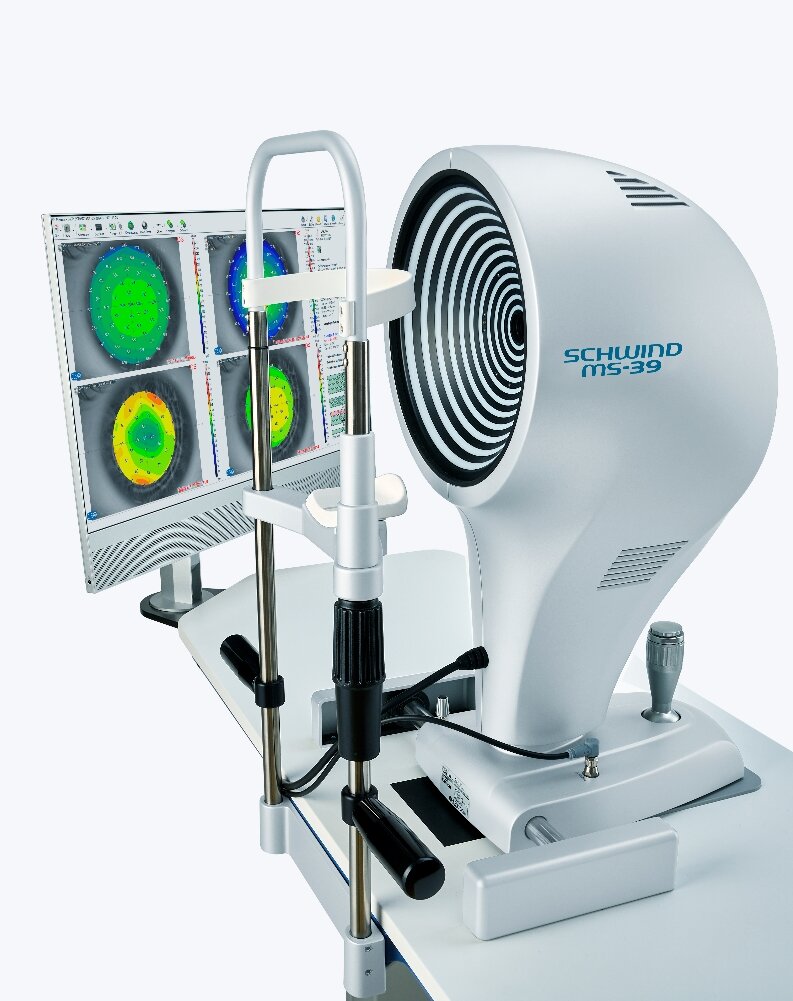
Diagnostics at EyeLaser Vienna – SCHWIND MS-39: the most Advanced System for Corneal Analysis

SCHWIND MS-9

An exact diagnosis is crucial for reliably detecting keratoconus and correctly assessing its stage.
At EyeLaser Vienna, we use the SCHWIND MS-39 (Spectral Domain OCT + Placido Topography) – currently the most advanced device for three-dimensional corneal diagnostics.

Advantages of MS-39 Diagnostics:

  • Combination of optical coherence tomography (OCT) and topography
  • Anterior and posterior surface analysis of the cornea with micrometer precision
  • Pachymetry (thickness measurement) at thousands of points
  • Epithelial thickness measurement (epithelial mapping) for early detection of initial changes
  • 3D display for monitoring the course of the condition

Epithelial analysis is now a crucial early indicator:
Even before topographic changes become visible, the epithelium shows subtle irregularities that may indicate the onset of keratoconus. This allows us to identify risks earlier – and take action in good time.

Therapeutic Concept at EyeLaser Vienna

Our principle:
As gentle as possible, as effective as necessary.

Depending on the stage, corneal thickness, and individual visual situation, we will create a customized treatment plan for you.

1. Early stage – Improving visual acuity with special lenses

In early stages or with a stable progression, the focus is on vision correction.

  • Rigid gas permeable (hard) contact lenses:
    They create a new, smooth optical surface through the tear film and compensate for irregularities in the cornea.
  • Scleral lenses:
    These larger, rigid lenses rest on the sclera (white of the eye). They offer high wearing comfort and very stable visual quality – even in advanced keratoconus.


2. Progressive Keratoconus – Crosslinking (CXL)

The goal of crosslinking is to stabilize the corneal structure.
Riboflavin (vitamin B2) is applied to the cornea and activated with UV-A light.
The resulting cross-links strengthen the collagen and prevent further thinning.

  • At EyeLaser Vienna, we use individual crosslinking protocols, even for very thin corneas down to approx. 250 µm residual thickness.
  • This enables safe treatments even in complex cases.
  • Detected early – e.g., via epithelial mapping with MS-39 – CXL can stop the progression in over 95% of cases.
3. Combination therapies for vision improvement

If stabilization alone is not sufficient, we combine procedures to improve the optical quality of the cornea.

  • PRK + CXL (Photorefractive Keratectomy + Crosslinking):
    Here, the irregular corneal surface is smoothed with the excimer laser, and then immediately stabilized with CXL.
  • PTK + CXL (Phototherapeutic Keratectomy + Crosslinking):
    This variant is particularly suitable for superficial scars or irregular epithelial structures.
    It removes minimal tissue to homogenize the optical surface and combines this directly with crosslinking.
  • CAIRS (Corneal Allogenic Intrastromal Ring Segments):
    Biological ring segments made of donor tissue – a natural alternative to plastic implants to improve the corneal shape.
  • ICRS (Intracorneal Ring Segments):
    Plastic rings that are precisely inserted into the cornea with the femtosecond laser to reduce bulging and improve visual quality.
4. Advanced cases – Corneal transplantation (DALK)

If the cornea is too thin or scarred, a DALK (Deep Anterior Lamellar Keratoplasty) may be necessary.
Only the anterior, diseased part of the cornea is replaced, while the innermost cell layer is preserved.
Advantage: significantly lower risk of rejection and better long-term results than with a complete transplant.

Why EyeLaser Vienna?

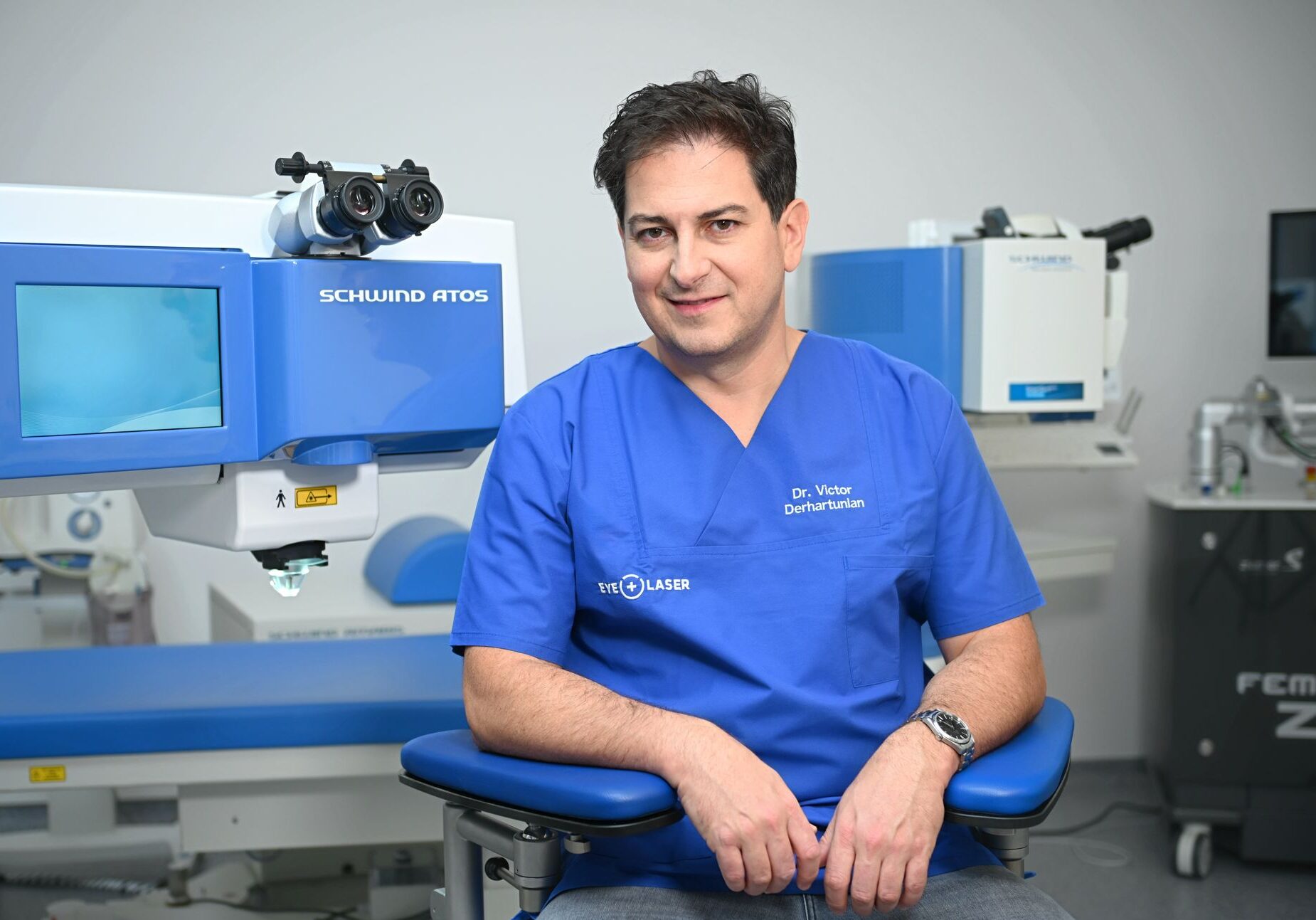
Dr. Victor Derhartunian
  • Comprehensive care:
    From screening and crosslinking to complex corneal procedures – all from a single source.
  • State-of-the-art technology:
    SCHWIND MS-39 + the most precise femtosecond lasers for all procedures.
  • Specialized expertise:
    Decades of experience in the field of cornea, keratoconus and refractive surgery.
  • Austria-wide network:
    Many patients travel from all over Austria; we work closely with ophthalmologists in Lower Austria and Burgenland.
  • Transparent costs:
    We provide open advice on possible health insurance benefits and support you with the application.

Start a life without reading glasses

Would you like to have your cornea examined or get a second opinion?
Arrange your personal keratoconus consultation at EyeLaser Vienna – with precise diagnostics and individual therapy recommendations.

Or call us directly: +43 50 236

When we say no: We only perform cross-linking if the keratoconus is demonstrably progressing; a stable cornea is not treated. We decline laser vision correction on an untreated keratoconus cornea. In advanced thinning or central scarring we speak openly about CAIRS or transplantation instead of raising expectations cross-linking cannot meet.
Experience you can measure: Several hundred cross-linking treatments, including laser-combined protocols · around 100 CAIRS procedures · over 25,000 laser procedures by Dr. Derhartunian · in Vienna since 2012.
Request my consultation now

Frequently asked questions (FAQ)

4,9 von 5 – über 240 Google-Bewertungen für EyeLaser Wien & Linz