


What is wavefront LASIK?
Dr. Victor Derhartunian explains what a wave front is.
A wavefront is a description of optical irregularities that can be expressed either only on the pure cornea or in the entire eye.
A wavefront treatment is a treatment where these irregularities are corrected.
We distinguish between two types of wavefront treatments.
The so-called wavefront-optimized treatment, in which mainly the so-called spherical aberrations are corrected or are not induced.
These are visual defects that can cause halos and glare, especially at night.
The second point is the so-called wavefront-guided treatments.
This involves taking all the data from your eye and feeding it into the laser and correcting it precisely.
This type of treatment is mostly used for repairs or for very complex visual defects.
Otherwise, wavefront-optimized treatment is used as standard.
Auf dieser Seite4 Abschnitte
What does the wavefront measure?
Light entering the eye can be described as a wave. In an optically ideal eye, this wave arrives at the retina as a smooth surface. Every deviation from it is an aberration. Short-sightedness, long-sightedness and astigmatism are lower-order aberrations, which glasses or contact lenses can also correct. In addition, there are higher-order aberrations such as coma or spherical aberration. No glasses correct them. They show up as halos, double contours or poorer vision at dusk.
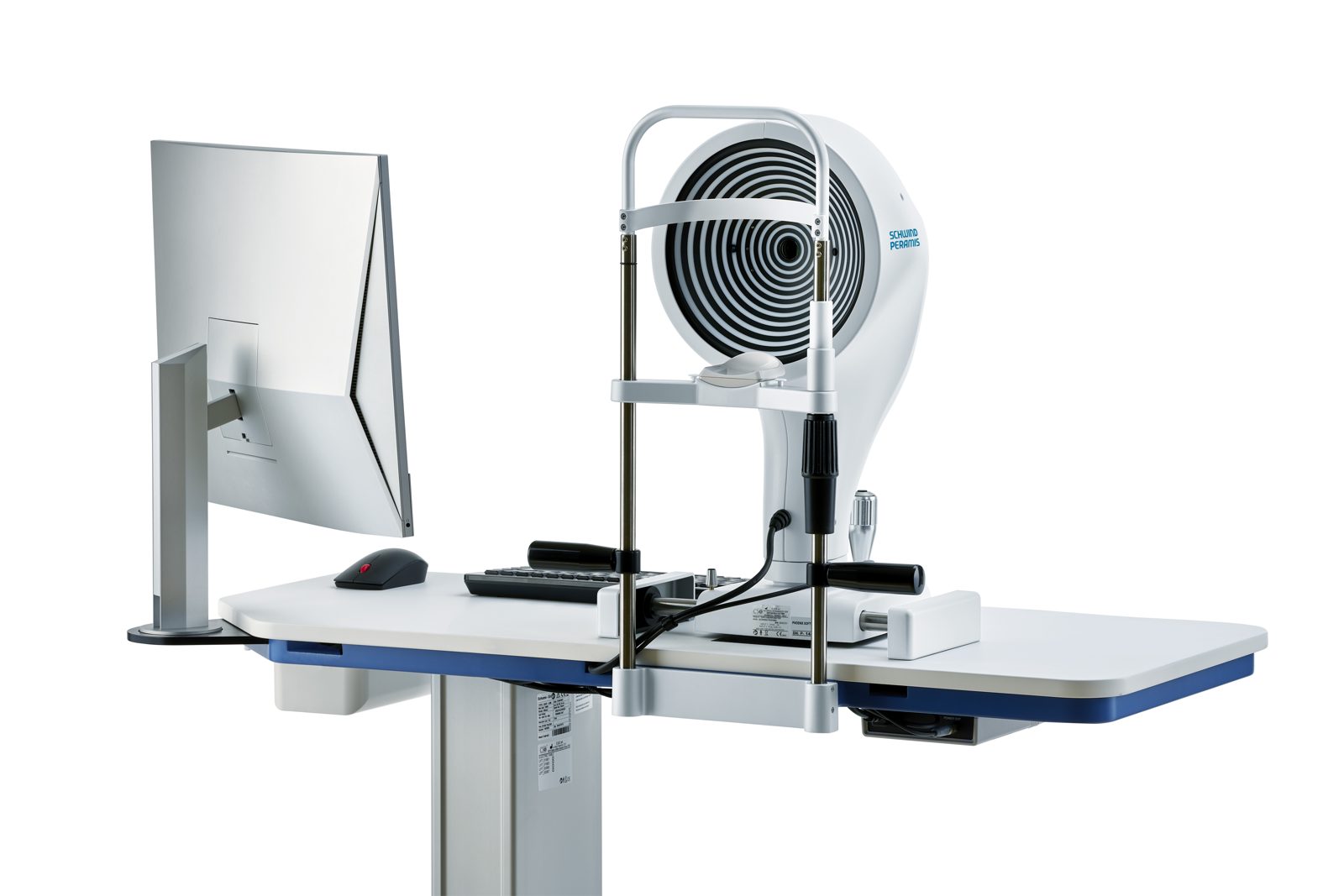
There are two ways to measure it. We calculate the wavefront of the cornea from the corneal measurement with the SCHWIND MS-39. The wavefront of the whole eye, i.e. cornea and lens together, is measured by an aberrometer such as the SCHWIND PERAMIS.
Wavefront-optimised or wavefront-guided?
| Wavefront-optimised | Wavefront-guided | |
|---|---|---|
| Goal | Correct the refractive error without creating new aberrations, above all no additional spherical aberration | Also treat the measured higher-order aberrations in a targeted way |
| Basis | Glasses prescription and corneal measurement | Individual wavefront measurement of the cornea or the whole eye |
| Use at EyeLaser | Standard for most eyes | For re-treatments, after previous procedures and for complex refractive errors |
CustomEyes: individual treatment with SCHWIND
CustomEyes is SCHWIND’s planning module for wavefront-guided treatments on the AMARIS excimer laser. It uses the wavefront of the cornea from the MS-39 or the wavefront of the whole eye from the PERAMIS and is used to select which aberrations are treated. The idea behind it: not every measured aberration affects vision, and treating only the relevant ones removes less corneal tissue [1, 2]. For re-treatments based on the corneal wavefront, follow-up data over four years are available [3]. CustomEyes is available at EyeLaser.
Who benefits from a wavefront-guided treatment?
The measurement decides. If higher-order aberrations are small, an individual treatment often brings no measurable advantage over the wavefront-optimised one. It is useful above all when significant higher-order aberrations are measured, for example after previous laser treatments, with a decentred treatment zone or with an irregularly shaped cornea. During the preliminary examination we measure the wavefront and discuss with you which treatment suits your eyes. The free suitability test gives you a first overview; you can find more on the procedures under Femto-LASIK and Trans-PRK.
Sources
- Arba Mosquera S, de Ortueta D, Merayo-Lloves J. Tissue-Saving Zernike Terms Selection in Customized Treatments for Refractive Surgery. J Optom. 2009;2(4):182–196. doi:10.3921/joptom.2009.182
- Arba Mosquera S, de Ortueta D. Optimized Zernike term selection in customized treatments for laser corneal refractive surgery: case report. J Refract Surg. 2011;27(2):148–152. doi:10.3928/1081597X-20100224-01
- Aslanides IM, Kolli S, Padron S, Arba Mosquera S. Stability of Therapeutic Retreatment of Corneal Wavefront Customized Ablation With the SCHWIND CAM: 4-year Data. J Refract Surg. 2012;28(5):347–354. doi:10.3928/1081597X-20120410-01