What is a refractive lens exchange?

In brief

What
In refractive lens exchange your own lens is replaced by an artificial lens, the same procedure as cataract surgery, only for a different reason.
For whom
From about 55 years or with marked long-sightedness plus presbyopia; healthy retina. Younger and highly short-sighted patients are more likely to be advised PresbyMAX or ICL.
Duration
About 15 to 20 minutes per eye, outpatient; both eyes usually in the same session, separate days on request.
Back to work
Office work usually after 1 to 3 days. Getting used to multifocal lenses takes the first few weeks; full adaptation can take a few months.
Price
€3,500 per eye, fixed price for every lens type (monofocal, toric, EDOF, multifocal), incl. follow-up checks under the quality scheme. From €68/month.
Not suitable
High short-sightedness under 55 (retinal risk), untreated retinal or corneal disease, unrealistic expectation of freedom from glasses.

In refractive lens exchange, the natural lens is replaced with an artificial lens. The operation is the same as cataract surgery; only the reason differs.

At EyeLaser every lens type costs the same: monofocal, toric, EDOF or trifocal. Which lens is right for your eye is decided by the measurements, not by your budget.

Lifestyle lens exchange: spectacle-free with multifocal lens / EDOF lens

  • Cataract surgery: cataract (incl. holistic vision correction)
  • Correction: severe defective vision(s) incl. presbyopia & astigmatism

Standard lens exchange:
Premium monofocal lens

  • Cataract surgery: cataract (incl. correction of short- or long-sightedness)
  • Correction: severe visual impairment (reading glasses required)

Whether the lens is replaced because of a cataract, because of presbyopia or to correct a refractive error, the operation is always the same. What differs is the artificial lens: we choose it to suit your eyes and your everyday life.

Multifocal and EDOF lenses

If your eye is suitable, we implant a multifocal or EDOF lens. It corrects long-sightedness, short-sightedness and presbyopia, and as a toric version also astigmatism. With a trifocal lens most patients no longer need glasses; with an EDOF lens reading glasses are often still useful for small print. Like every artificial lens, it also replaces a lens clouded by cataract.

Multifocal lenses:

Multifocal lenses have several focal points, trifocal lenses three: for near, intermediate and distance vision. In return, rings of light (halos) can appear around light sources; they usually become less noticeable over time. Toric versions are available for astigmatism.

EDOF lenses:

EDOF lenses (extended depth of focus) give continuous sharp vision from distance to intermediate range, for example dashboard and screen. They cause fewer halos than multifocal lenses; for small print, reading glasses are often still needed.

Monofocal or toric lens: Not every eye is suited to a multifocal lens, for example with a large angle kappa, with diseases of the retina or optic nerve, or for people who drive a lot at night. We then implant a monofocal-plus or toric lens at the same price. This lens has one focal point and makes one distance sharp, usually the distance. Reading glasses are needed for near vision afterwards.

The toric version corrects astigmatism. A monofocal lens does not compensate for presbyopia; it is well suited to marked long-sightedness and to eyes with other conditions.

Do I meet the lens exchange requirements?

Lens exchange offers you a treatment option if you suffer from cataracts, presbyopia and possibly other visual defects. As a rule, we only perform cataract surgery or refractive lens exchange for patients who are older than 55 years or have pronounced long-sightedness (hyperopia).

For younger patients (without cataracts), laser eye surgery with PresbyMAX or an ICL phakic lens is an option. Conventional laser eye surgery is usually not the first choice if presbyopia is present.

Are you suitable? Free aptitude test at EyeLaser

Doctor in a white shirt advising a patient at a desk, next to an eye model

For patients who are considering lens surgery in order to finally have a clear view of the finer things in life (without glasses or contact lenses), we offer a free & non-binding suitability test:

0 Euro

What does a multifocal or EDOF lens offer you?

Smiling woman holding a tablet in front of a glass building

Several refractive errors with one operation: The multifocal lens corrects short-sightedness, long-sightedness and presbyopia, and as a toric lens also astigmatism.

No more cataract: The artificial lens stays clear; a cataract can no longer develop.

Usually without glasses: With a trifocal lens most patients see without glasses at distance, intermediate and near. For very small print or in poor light, reading glasses can remain helpful.

What does a monofocal or toric lens offer you?

Smiling woman with a smartphone outdoors in front of trees

No more cataract: The clouded lens is removed; a cataract cannot come back afterwards.

Sharp distance vision: You no longer need glasses for distance, but reading glasses for near.

One price for every lens: Monofocal, toric, EDOF or multifocal: lens surgery costs €3,500 per eye, with no surcharge for a premium lens. If a cataract is treated, Austrian public health insurance covers the operation in a public hospital, but without a free choice of surgeon.

Is the surgery performed with a femtosecond laser?

No. We remove the natural lens with ultrasound (phacoemulsification) through an incision of 2.2 to 2.4 mm. According to the recommendations of the European Society of Cataract and Refractive Surgeons (ESCRS), laser-assisted surgery (FLACS) is equivalent to the manual technique and does not measurably improve the visual acuity achieved. We therefore do not offer it, and there is no femtosecond laser surcharge.

Correction of presbyopia, defective vision & cataract surgery

Whichever artificial lens is right for your eye, the procedure is always the same. You will feel pressure and light, but no pain.

Allow about two hours for the whole visit. The lens exchange itself takes about 15 to 20 minutes per eye.

Preliminary examinations & preparation

At the preliminary examination we measure your eye and determine which artificial lens in which power suits you.

On the day of surgery your pupils are dilated with eye drops. After about 30 minutes the eye is anaesthetised with drops, so that the lens exchange is painless.

Cutting, shredding & vacuuming

First, a tiny incision (2.2 – 2.4 mm) is made at the edge of the cornea. This is necessary so that the lens capsule can be opened in a circular fashion. Using modified ultrasound (phacoemulsification), the natural lens is liquefied or fragmented and suctioned out.


If you decide to use the femtosecond laser, the incision is not made with a scalpel but with high precision using the laser. In both variants, the result is that the empty lens capsule (also known as the capsular bag) remains.

Inserting an artificial lens

The artificial lens (monofocal or multifocal lens) is then implanted through the tiny incision using an injector. The rolled lens can unfold and take the place of the natural lens. Subsequently, the substances used during the operation are suctioned out and the wound is sealed.

Aftercare

To prevent infection, we place an antibiotic in the anterior chamber at the end of the operation. Afterwards you receive eye drops that prevent inflammation. A protective shield protects the eye from rubbing during the first days. Please:

  • do not press on the operated eye
  • avoid physical exertion
  • avoid swimming pools and saunas
  • read little at first
  • follow the eye-drop schedule

We see you again for the first check-up the very next day.

Does lens exchange pay off compared with glasses?

The costs arise once. For comparison: in Austria, distance glasses with single-vision lenses cost €256.70 on average and varifocal glasses €552.50 (Spectra survey 2024 for the Austrian guild of opticians). Lens exchange for both eyes therefore corresponds to the price of almost thirteen pairs of varifocals. How quickly it pays off depends on how often you buy glasses or contact lenses.

With a cataract, no glasses help permanently; the clouding progresses until the lens is replaced.

More about health insurance cover and tax deductibility can be found on the lens surgery costs page.

Standard Linsenaustausch (Katarakt)
3.500 €
  • Price per eye
  • ab 48 Euro / Monat*
  • Katarakt, Alterssichtigkeit, Kurz- & Weitsichtigkeit
  • Hochwertige Standard Linsen (Lesebrille erforderlich)
  • Astigmatismus Korrektur nicht inklusive
Lifestyle lens replacement (cataract)
3.500 €
  • Price per eye
  • from 68 euros / month*
  • Katarakt, Alterssichtigkeit, Kurz- & Weitsichtigkeit
  • Spectacle-free thanks to custom-made multifocal lenses (trifocal / EDOF)
  • Astigmatismus Korrektur inklusive
Standard Linsenaustausch (Katarakt)
3.500 €
  • Price per eye
  • ab 48 Euro / Monat*
  • Katarakt, Alterssichtigkeit, Kurz- & Weitsichtigkeit
  • Hochwertige Standard Linsen (Lesebrille erforderlich)
  • Astigmatismus Korrektur nicht inklusive
Lifestyle lens replacement (cataract)
3.500 €
  • Price per eye
  • from 68 euros / month*
  • Katarakt, Alterssichtigkeit, Kurz- & Weitsichtigkeit
  • Spectacle-free thanks to custom-made multifocal lenses (trifocal / EDOF)
  • Astigmatismus Korrektur inklusive

* Financing over 60 months, effective annual interest rate 6.21 %. The full representative example is at the end of the page. Prices are per eye.

Refractive lens exchange Risks for the eye & lens

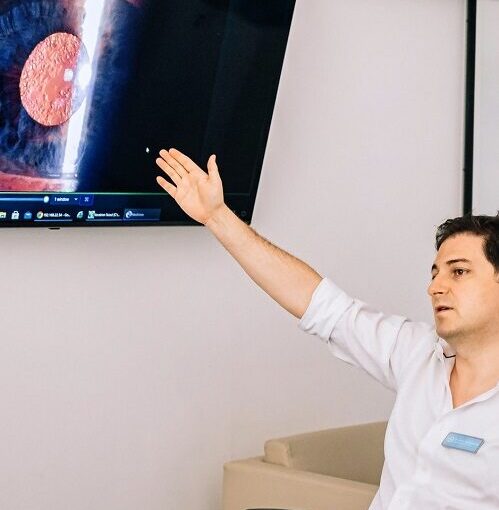
Doctor pointing to an eye image on a wall-mounted screen

Serious complications are rare. At the preliminary examination we explain the following risks:

  • Infection of the eye
  • Increased sensitivity to light and glare
  • Halos and reduced contrast in the dark, mainly with multifocal lenses
  • Swelling of the central retina (macular oedema), prevented with eye drops
  • Retinal detachment, clearly more frequent with high short-sightedness
  • Over- or under-correction, usually correctable with the laser on the cornea
  • After-cataract: removed with the YAG laser in a few minutes

No operation comes with a guarantee of success. We reduce the risk with a thorough preliminary examination including a retinal check, an antibiotic at the end of the operation and a check-up the next day.

Healing process & healing time for lens exchange surgery

Most patients notice clearly better vision right after the operation. Full sharpness takes a few days, because the brain first has to get used to the new lens. The first adaptation usually takes about two weeks; with multifocal lenses full adaptation can take a few months. Depending on the lens, you can do without glasses or need reading glasses for near vision.

If the lens is exchanged because of a cataract, the cloudy vision is gone. The new lens cannot cloud over, so a cataract cannot return.

Temporary symptoms during healing are usually harmless and pass by themselves:

  • slight burning
  • poorer vision at dusk and in the dark
  • halos around lights
  • foreign-body sensation

Lens exchange and cataract surgery are among the most frequent and best-studied operations. We accompany healing with check-ups according to our quality scheme. Please follow the eye-drop schedule and medical instructions; if anything unexpected happens, you can reach us at any time.

Differences to lens implantation:

Lens implantation is also part of lens surgery and differs from lens replacement in that the natural lens is not removed during implantation. Instead, a phakic lens (EVO/EVO+ VISIAN ICL) is also implanted, which can correct your visual defect.

Especially for patients who do not have cataracts suffer from a suffer from severe defective vision (short-sightedness, long-sightedness, presbyopia and astigmatism) and are not suitable for laser eye surgery for laser eye surgery – e.g. because the cornea is too thin or the eyes are dry – the Phake lens is an excellent way to become independent of visual aids and finally have sharp vision again.

Find out more about lens implantation!

Arrange a non-binding aptitude test & preliminary examination

Whether lens exchange or an ICL suits you, we clarify at the free suitability test or at the preliminary examination (200 euros incl. treatment plan)* in Vienna or Linz.

Would you like to know what is possible for you?
Take the free suitability test

Would you like a full examination?
Book the preliminary examination* online

* No risk: if the preliminary examination shows that you are not suitable, or you decide against treatment at EyeLaser, we only charge for the eye examination.

FAQ: Refractive lens exchange at the laser eye center

Can I replace an artificial lens?

Removing and replacing an artificial lens is possible in principle, but it is a considerably larger operation than the first lens exchange. EyeLaser does not offer the exchange of an already implanted artificial lens. If a small refractive error remains after lens exchange, it can usually be corrected with the laser on the cornea, from €1,950 per eye.

How long does a multifocal lens last?

Artificial lenses usually stay in the eye for life. They do not cloud over and do not age. If an after-cataract appears months or years later, it affects the lens capsule, not the artificial lens, and is removed with the YAG laser in a few minutes.

When can I return to work?

For office work usually after 1 to 3 days. For physically heavy, dusty or dirty work, we agree the length of sick leave with you at the check-up.

What types of multifocal lenses are there?

We mainly implant trifocal lenses, which cover distance, intermediate and near vision. There are also EDOF lenses with extended depth of focus: they cover distance and intermediate range, cause fewer halos and often still need reading glasses for small print. Both are available as toric versions for astigmatism.

Are new lenses covered by health insurance?

It depends only on whether a cataract is present, not on which lens is used. With a cataract, the operation is a public health insurance benefit: in a public hospital the Austrian health insurance (ÖGK) covers it in full with a standard monofocal lens, but without a free choice of surgeon and with a waiting time. At EyeLaser you are a private patient and pay the full price; there is no top-up on the insurance benefit in a private clinic. Without a cataract, refractive lens exchange is an elective treatment without insurance contribution. Some private supplementary insurance plans contribute; ask before treatment, we provide a clinical report.

Your laser eye surgery specialists at the Eye Laser Center Austria

Dr. Victor Derhartunian, FEBO, FWCRS & Dr. Paul Jirak, FEBO, in Vienna & Linz – recognised by patients with the DocFinder Patients’ Choice Award

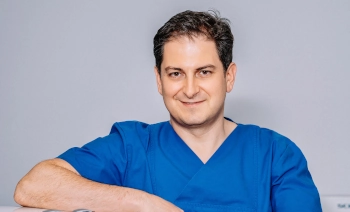
Dr. Victor Derhartunian in blue surgical scrubs, smiling against a grey background
Ophthalmologist, specialist in refractive surgery
FEBO

Dr. Victor Derhartunian, FEBO, FWCRS, heads EyeLaser Vienna and has performed more than 25,000 laser procedures. He advises patients in German, English, Polish and French.

Learn more
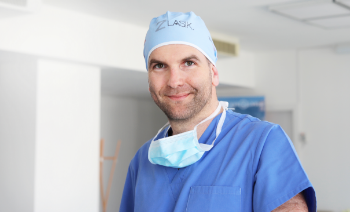
Dr. Paul Jirak smiling in surgical scrubs in the treatment room
Ophthalmologist, specialist in refractive surgery
FEBO

Dr. Paul Jirak, FEBO, is a specialist in ophthalmology and co-founder of a laser eye surgery centre in Austria. He has been treating patients in Linz since 2014. His focus is eye surgery and laser eye surgery.

Learn more
Assoc. Prof. Priv.-Doz. Dr. Christina Leydolt smiling in front of a window
Ophthalmologist, specialist in artificial lenses and cataracts
FEBO

Dr. Leydolt is an ophthalmologist and specializes in cataract and lens surgery. She heads a research group with this focus, trains young surgeons and gives international lectures.

Learn more
Dr. Victor Derhartunian in blue surgical scrubs, smiling against a grey background
Ophthalmologist, specialist in refractive surgery
FEBO

Dr. Victor Derhartunian, FEBO, FWCRS, heads EyeLaser Vienna and has performed more than 25,000 laser procedures. He advises patients in German, English, Polish and French.

Learn more
Dr. Paul Jirak smiling in surgical scrubs in the treatment room
Ophthalmologist, specialist in refractive surgery
FEBO

Dr. Paul Jirak, FEBO, is a specialist in ophthalmology and co-founder of a laser eye surgery centre in Austria. He has been treating patients in Linz since 2014. His focus is eye surgery and laser eye surgery.

Learn more
Assoc. Prof. Priv.-Doz. Dr. Christina Leydolt smiling in front of a window
Ophthalmologist, specialist in artificial lenses and cataracts
FEBO

Dr. Leydolt is an ophthalmologist and specializes in cataract and lens surgery. She heads a research group with this focus, trains young surgeons and gives international lectures.

Learn more

Frequently asked questions (FAQ) about refractive lens exchange

Refractive lens exchange offers a permanent solution for severe visual defects and presbyopia. Here you can find out everything you need to know about this procedure: who it is suitable for, what types of lenses are available and how the treatment works.

What is a lens exchange and who is it suitable for?

Lens replacement is part of lens surgery and is a procedure in which the natural lens of the eye is removed and replaced with an artificial lens. In addition to the treatment of cataracts, this procedure is particularly suitable for people who already suffer from presbyopia, want to prevent the development of a cataract or have severe visual defects that cannot be easily treated with laser eye surgery.

How does lens replacement differ from cataract surgery?

The procedure for cataract surgery and lens exchange is the same. Only the reason differs. Here, the lens is not removed because it is cloudy. Rather, a visual defect is the reason—whether it be presbyopia, short-sightedness, long-sightedness, or astigmatism. The goal of lens exchange is to enable the patient to live a glasses-free life with clear vision.

What types of lenses are used for lens exchange?

We use monofocal lenses (one focal point, reading glasses needed for near), trifocal lenses (distance, intermediate and near; most patients no longer need glasses) and EDOF lenses (distance to intermediate with few halos; reading glasses often still needed for small print). Toric versions correct astigmatism. All cost the same.

What are the advantages of lens replacement for presbyopia or visual defects?

Lens replacement is a procedure that usually only needs to be carried out once. The lens can then remain in the eye permanently. It also offers a long-term solution for visual defects and presbyopia. Independence from glasses and contact lenses improves the quality of everyday life. In addition, cataracts can no longer occur once the natural lens has been replaced with an artificial lens. The procedure therefore also has a preventive character.

How does the treatment day for lens surgery work?

On the day of treatment, after a final preliminary consultation, the eye is anaesthetized with eye drops so that the procedure is perceived as painless for most people. The operation then begins, during which a tiny incision is made, the natural lens is broken up and replaced with the chosen artificial lens. This usually only takes 15 to 20 minutes. After a short recovery period in the practice, you can go home the same day and the healing process begins. Many patients are already reporting a noticeable improvement in their vision.

Honestly asked

What if …? The most common worries before lens exchange

Almost everyone who comes to us has the same questions in mind and does not always dare to ask them. Here are the honest answers.

“Does it hurt?”

No. The eye is numbed with drops, with light sedation on request. The operation takes about 15 to 20 minutes per eye; you feel pressure and light, no pain. Afterwards a scratchy feeling for a few hours that quickly eases with the drops.

“Which lens is the right one?”

The measurements decide, not the price: with us every lens costs the same. Monofocal for maximum sharpness at one distance, EDOF for distance and screen with few halos, multifocal for extensive freedom from glasses, toric for astigmatism. We discuss the trade-off of each lens openly with you.

“Will I see halos at night?”

With multifocal lenses halos around light sources can occur, especially in the first weeks; the brain usually adapts (neuroadaptation). If you drive a lot at night or are sensitive to glare, we are more likely to recommend an EDOF or monofocal lens.

“Could I go blind?”

Lens exchange is one of the most frequent procedures in medicine. The serious risks are rare: infection (sterile theatre, antibiotic), retinal detachment (which is why we often decline highly short-sighted patients under 55), swelling of the central retina (preventable with drops). We check the retina before every operation and see you again the next day.

“Will I have to repeat this later?”

No. The artificial lens stays permanently; it does not cloud and does not age. A cataract can no longer develop after a lens exchange. What is possible is a secondary cataract, a clouding of the lens capsule; it is cleared painlessly with the YAG laser in a few minutes.

“I don’t dare to make a decision.”

You don’t have to today. The first step is a preliminary examination with the chief surgeon, without obligation. Only the measurements show whether lens exchange is the right path for you at all. After that you have as much time to think as you need. Nobody at our clinic is pushed into an appointment.

We answer further questions in the FAQ below or in person at the suitability check.

What patients say

Reviews

4.9 out of 5 from 244 Google reviewsAll reviews on Google →Patient stories with video →

„I was looked after excellently and kindly by the EyeLaser team and decided on ICL lens surgery as a result. You are given all the information you need for the operation and for the time afterwards.”

Thomas M. · Google review (translated from German), July 2026

„From the very first moment I felt in the best hands with Dr. Derhartunian. The whole team is incredibly friendly, well organised and really takes time for every patient.”

Ralf P. · Google review (translated from German), July 2026
4,9 von 5 – über 240 Google-Bewertungen für EyeLaser Wien & Linz