

European Center for Refractive Corneal Repair & Treatment of Laser Eye Surgery Complications
A refractive eye surgery is meant to provide freedom. However, when complications occur—whether due to outdated technology, anatomical peculiarities, or inadequate diagnostics in previous treatments—patients often suffer from severe limitations. Blurred vision, ghost images, extreme glare sensitivity, or chronic pain can significantly impair daily life and have an isolating effect.
The most important message for you is: You do not have to settle for a poor result.
Modern refractive surgery today offers revolutionary possibilities to correct even the most complex side effects of previous treatments (such as PRK, LASIK, SMILE, SmartSight, or lens implantations). As a specialized center for corneal repair in Vienna, Austria, we offer patients from across Europe and the world a facility that combines the highest surgical expertise with state-of-the-art artificial intelligence. We do not guess—we calculate your new vision.
Auf dieser Seite5 Abschnitte
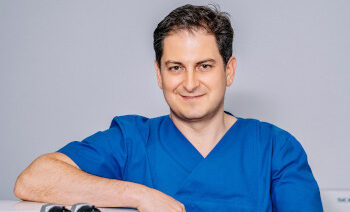
Dr. Victor Derhartunian: Your Expert for Complex Laser Eye Surgery Repairs
Repairing an already operated eye requires many times more experience compared to an initial treatment. Dr. med. univ. Victor Derhartunian, FEBO, FWCRS is among the few surgeons worldwide who specialize in this demanding field.
- Pioneer of AI Technology: As a worldwide Key Opinion Leader (KOL) and sought-after speaker at international conferences for Schwind Eye-Tech Solutions, Dr. Derhartunian is one of the global pioneers in the application and development of ForeSight AI technology.
- Academic Excellence: He learned his craft directly from the inventors and masters of refractive surgery—including Prof. Dr. Theo Seiler (inventor of corneal crosslinking and PRK), Prof. Dr. Thomas Kohnen, and Dr. Jerry Tan (Singapore).
- Surgical Mastery: With the experience of over 25,000 successfully performed eye surgeries, he also handles the most complex external cases and revision procedures to restore the best possible vision.
Diagnostic Superiority: We Measure the Invisible
To repair a damaged cornea or a lens problem, we need data that standard devices cannot provide. EyeLaser Vienna has a diagnostic arsenal of absolute world-class quality:
- Corneal Wavefront with the MS39 (2nd Generation, AL): This high-end device combines Placido ring systems with high-resolution OCT technology. It scans the anterior segment with over 100,000 measurement points. It provides us with a micrometer-precise 3D map of the cornea to identify irregular astigmatism and tissue weaknesses down to the deepest layers.
- Ocular Wavefront with the PERAMIS Aberrometer: The Peramis uses a state-of-the-art pyramidal wavefront sensor. With 45,000 extremely high-resolution measurement points, it analyzes the optical errors of the entire eye in real time. We see exactly what you see—including all optical distortions (higher-order aberrations).
- ForeSight AI – The Future of Surgical Planning: As one of the first centers worldwide, we use Schwind ForeSight AI. This artificial intelligence simulates the surgical outcome before the procedure. It precisely calculates how the laser beam must interact with the individual corneal topography to minimize side effects such as halos or ghosting. We plan your visual outcome in virtual reality before the Schwind Amaris 1050RS laser is activated.
Complications We Treat and Repair
We correct complications from all refractive previous treatments, whether old PRK/LASIK methods, modern lenticule extractions (SMILE), or intraocular lenses.
1. Corneal Ectasia (Keratectasia) After LASIK or SMILE
A dangerous bulging and thinning of the cornea, often years after the initial procedure. We not only stabilize it, we also actively improve vision:
- CAIRS Implantation (Corneal Allogenic Intrastromal Ring Segments): Instead of rigid plastic rings, we implant biocompatible human donor tissue into the cornea to flatten the ectasia “cone” and gently stabilize the eye.
- Customized Crosslinking (CXL + Laser): A combination of topography-guided laser smoothing and subsequent UV hardening of the cornea according to Prof. Seiler’s protocols.
2. Optical Side Effects & Refractive Errors (PRK, LASIK, SMILE)
- Halos, Starbursts & Glare: Through ForeSight AI and wavefront-guided Trans-PRK (SmartSurfACE), we enlarge optical zones that are too small with millimeter precision.
- Ghosting & Double Vision (Diplopia): Often caused by decentered (shifted) ablations with older lasers. We recenter the optical zone with the 7D eye tracker onto your actual visual axis.
- Incomplete Lenticule Extraction: When tissue remnants remain after SMILE or SmartSight, we correct the resulting irregularities with microscopic precision.
3. Complications After ICL & Lens Implantations
Intraocular lenses (such as the EVO ICL) are extremely sensitive to miscalculations during the initial surgery. We correct:
- Incorrect Vaulting (Lens Distance): If the ICL sits too high, a glaucoma attack is imminent; if it sits too low, the natural lens can become cloudy (cataract). We analyze the position with OCT and exchange the lens precisely.
- Rotation of Toric Lenses: A rotated ICL leads to massive corneal astigmatism. We reposition the implant exactly to the required axis.
- Endothelial Cell Loss or Intolerance: Safe explantation and, if necessary, switching to alternative premium procedures.
Individual Solutions Require Individual Planning (Costs & Prices)
A repair procedure is the pinnacle of ophthalmology and not a standard procedure. Therefore, we take particular care in analyzing complication cases. Since the spectrum ranges from topography-guided re-treatment to highly complex procedures (CAIRS + crosslinking or ICL exchange), repairs cannot be priced uniformly.
All costs are individually and transparently agreed upon with you after the comprehensive diagnostics, based on the exact level of complexity.
Take new courage. Trust in measurable data, artificial intelligence, and the expertise of over 25,000 surgeries. Contact the EyeLaser team in Vienna for your initial examination.
Frequently Asked Questions (FAQ) About Laser Eye Surgery & Lens Complications
Can a botched LASIK or SMILE surgery be repaired?
Yes, in the vast majority of cases. Even severe optical side effects such as decentered optical zones, irregular astigmatism, or tissue irregularities after SMILE can now be repaired or significantly alleviated thanks to AI-assisted wavefront analyses (ForeSight AI) and high-precision lasers (Schwind Amaris). We calculate the repair ablation with micrometer precision.
What can be done about halos, starbursts, and glare sensitivity at night?
These phenomena often occur when the treated optical zone of the initial surgery is smaller than your pupil in darkness. With a wavefront-guided retreatment (often contact-free via Trans-PRK), we can enlarge and harmonize the optical zone, thereby massively reducing halos and glare.
My ICL lens is causing problems (eye pressure, poor vision) – what now?
Problems after lens implantation often stem from incorrect “vaulting” (the distance of the ICL from the natural lens) or rotation of a toric lens. With our high-resolution MS39 OCT, we analyze the lens position precisely. An ICL can be minimally invasively repositioned, exchanged, or completely removed.
What is corneal ectasia and is it curable?
Keratectasia is a dangerous bulging of the cornea that can occur months or years after LASIK or SMILE. We can stop the process through “customized crosslinking” (CXL). To improve vision again, we use state-of-the-art CAIRS implantations (natural donor tissue) to flatten the cornea.
How long must I wait after the initial surgery before a repair is possible?
This depends on the type of complication. Refractive fluctuations often require a waiting period of 3 to 6 months until the eye has stabilized. However, in acute problems (e.g., high ICL vaulting, flap folds after LASIK, or severe inflammation), immediate action must be taken. Early diagnostics are therefore crucial.
Can extremely dry eyes (dry eye syndrome) after LASIK be treated?
Yes. Chronically dry eyes after laser eye surgery often result from severed corneal nerves or an altered corneal shape. Before planning a surgical repair procedure, we stabilize the ocular surface with state-of-the-art therapies (e.g., punctum plugs or autologous serum drops). In some cases, we also collaborate with specialists for scleral lenses to protect the cornea and rehabilitate vision.
Is a second procedure (repair) more dangerous than the first surgery?
A repair is more complex than an initial treatment because the tissue has already been altered. However, with the right technology, it is highly safe. Thanks to our contact-free methods (Trans-PRK) and pre-operative simulation through ForeSight AI, we minimize risk. We only perform a revision procedure when our measurements (with the MS39 OCT) guarantee an absolutely safe residual corneal thickness.
Does health insurance cover the costs for the repair of laser eye surgery complications?
As a rule, refractive procedures are considered private services. However, if it involves medically necessary reconstructions—such as stopping a dangerous corneal ectasia through crosslinking (CXL)—partial costs may be reimbursed by private or statutory insurance in certain cases. We are happy to advise you individually after your initial examination.