The EyeLaser Triage: Two Paths to Glasses-Free Vision

Not all lens implantations are the same. The choice of the right procedure largely depends on your age, your diopters, and the anatomy of your eye. We strictly differentiate between two high-end procedures:

Often confused

ICL or lens exchange: what is the difference?

“Lens implantation” is the umbrella term for two different procedures. The difference is what happens to your own lens: with the ICL, an additional lens is placed in front of your own lens, which stays. With lens exchange, your own lens is removed and replaced by an artificial lens. At EyeLaser, both cost €3,500 per eye.

ICL: a lens is added / Lens exchange: the lens is replacedSchematic section through the front of the eye. Left: the ICL sits behind the iris in front of the natural lens, which is kept. Right: the natural lens has been removed and an artificial lens sits in the capsular bag.ICL: a lens is addedLens exchange: the lens is replacedLightCorneaIrisICLnatural lens (stays)LightCorneaIrisArtificial lensCapsular bag
Schematic illustration, not to scale.
ICL (phakic lens) Lens exchange
Your own lens stays in the eye is removed and replaced
Reversible yes, the ICL can be removed again no, permanent
Typical age 21 to 60 according to the approval, usually younger from about 50 to 55
Reading glasses (presbyopia) remain if already needed can be treated as well with a multifocal or EDOF lens
Cataract later on possible; the ICL is then removed during surgery can no longer develop
High short-sightedness well suited usually advised against before about 55 to 60 (retinal risk)
Price at EyeLaser €3,500 per eye €3,500 per eye

Which option suits me?

Younger than about 45, no reading glasses yetUsually the ICL. More on this further down this page.
Over about 55, reading glasses needed or the lens is starting to cloudUsually lens exchange: lens exchange in Vienna.
In between, or very high short-sightednessThe pre-operative examination decides: we measure the anterior chamber, endothelial cells, your own lens and the retina.
Close-up of a green-blue eye with long eyelashes
In brief

What
Two paths with an artificial lens: the ICL is placed in addition, in front of your own lens (reversible); in a lens exchange your own lens is replaced.
For whom
ICL: 21 to 60 years according to the approval, from 18 if the prescription is stable; high refractive error or thin cornea, anterior chamber deeper than 2.8 mm. Lens exchange: from about 50 to 55 with presbyopia or beginning cataract.
Duration
10 to 20 minutes per eye, outpatient, with anaesthetic drops.
Back to work
Usually after 1 to 3 days; full visual quality after 2 to 4 weeks.
Price
€3,500 per eye, fixed price for every lens type (monofocal, toric, EDOF, multifocal), incl. follow-up checks under the quality scheme. From €68/month.
Not suitable
Anterior chamber too shallow or too few endothelial cells (ICL), high short-sightedness under 55 (lens exchange), untreated eye disease, pregnancy.

Path 1: The EVO ICL Lens (The Invisible Contact Lens)

Your own eye lens is still fully flexible, but cannot correct your extremely high short-sightedness or long-sightedness, or your cornea is too thin for a laser.

  • The Principle: We remove nothing from your eye. We insert an additional, wafer-thin artificial lens (EVO Visian ICL) between your iris and your natural lens.
  • The Material (Collamer): It is a revolutionary mix of collagen and polymer. It is 100% biocompatible, has UV protection, and is “anti-deposit” (no annoying protein deposits form on the lens).
  • The biggest advantage: Reversibility. The procedure can be reversed at any time in a few minutes.
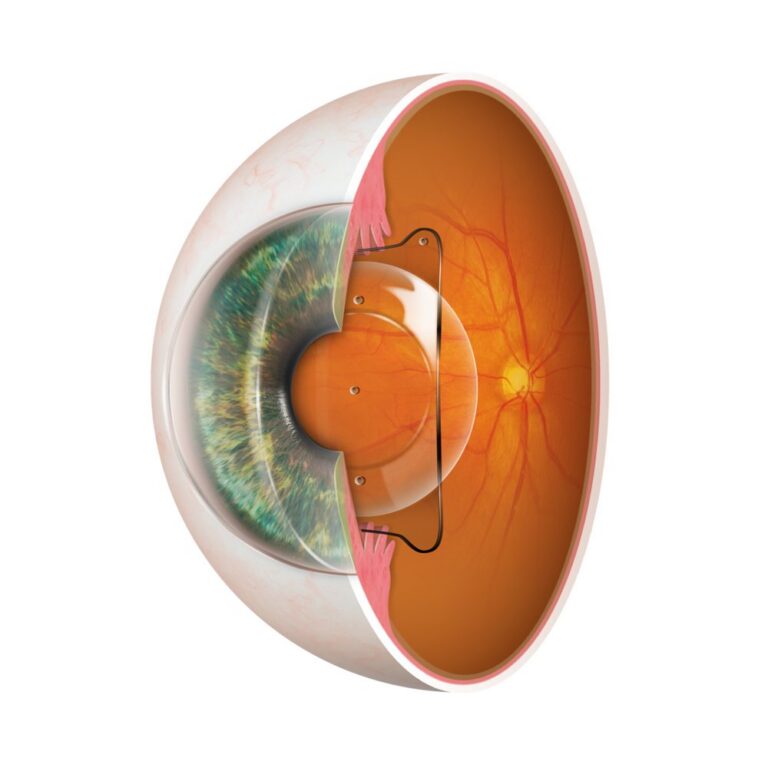
Illustration of a cut-away eye: the EVO ICL sits behind the iris and in front of the natural lens
Position in the eye: the EVO ICL sits behind the iris and in front of your natural lens, which is preserved.
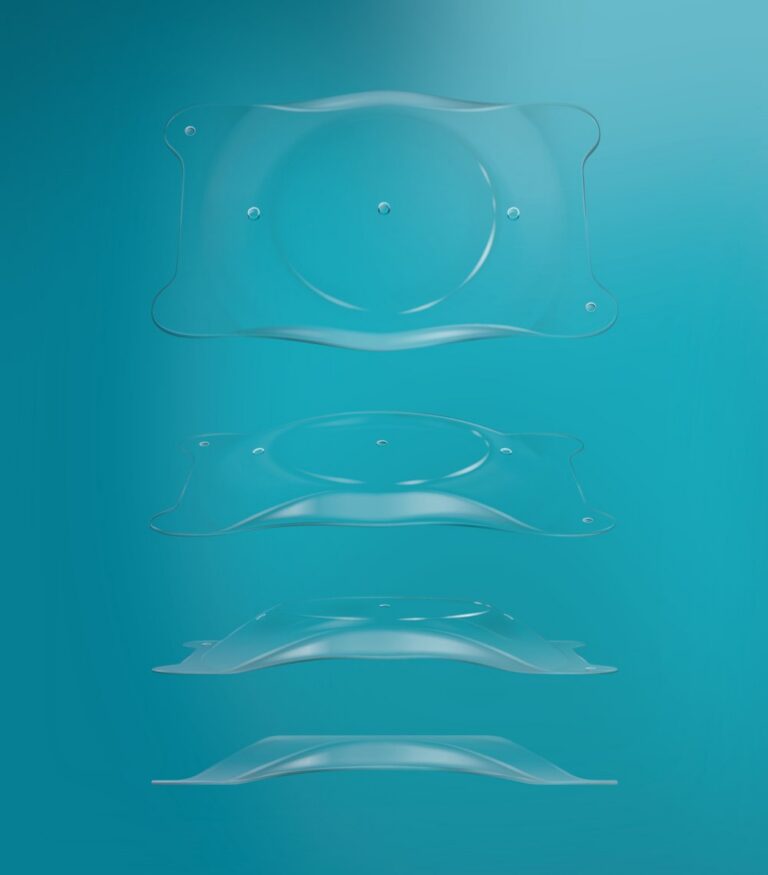
The EVO ICL from several angles, from a top view to a flat side view, on a turquoise background
The EVO ICL from several angles: wafer-thin, slightly curved and soft enough to be rolled up.

Illustrations: STAAR Surgical.

What does the EVO ICL look like?

EVO ICL made of Collamer: the KS-AquaPORT opening in the center and four haptics on the outside that hold the lens in place. Before insertion, the lens is rolled up and placed in the eye through a 2 to 3 mm opening. Visualization: STAAR Surgical.
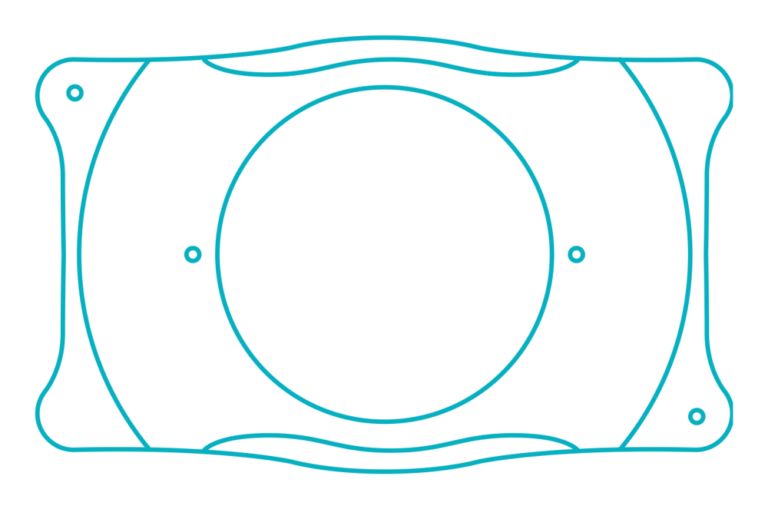
Line drawing of an older ICL generation: optic zone without an opening in the center
Older ICL generation: no central hole. Before surgery, a small hole had to be lasered into the iris (iridotomy).
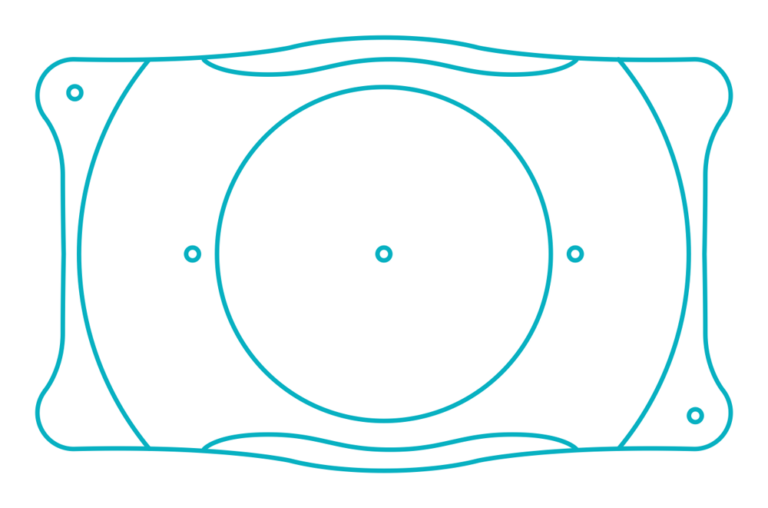
Line drawing of the EVO ICL: the KS-AquaPORT opening, 0.36 mm in diameter, in the center of the optic zone
EVO ICL: KS-AquaPORT opening (0.36 mm) in the center. Aqueous humor circulates through it, so no iridotomy is needed.

Same design, one difference: the opening in the center of the lens. Drawings: STAAR Surgical.

How aqueous humor flows through the central KS-AquaPORT opening of the EVO ICL: the eye’s natural circulation is preserved, and no iridotomy is needed. Animation: STAAR Surgical.
Close-up of a blue eye with a clearly visible iris

Path 2: Refractive Lens Exchange / RLE (The Permanent Upgrade from 50)

Your own lens is losing elasticity (presbyopia/reading glasses) or beginning to cloud.

  • The Principle: The aging natural lens is microsurgically removed through a tiny incision and replaced with a premium artificial lens (EDOF or trifocal).
  • The biggest advantage: Cataract prevention. You not only correct your presbyopia but can also never suffer from cataracts again in your lifetime.

The Retinal Risk: Why We Often Decline Myopic Patients Over 45

Many clinics operate on every patient over 45 with a lens exchange (RLE) to correct presbyopia. We at EyeLaser Vienna do not do that.

Smiling older couple sitting close together on a light-coloured sofa

If you are severely short-sighted, your eyeball has grown anatomically too long. This means your retina at the back of the eye is under constant mechanical tension. If we now remove your natural, voluminous lens during a lens exchange and replace it with a very flat artificial lens, the pressure conditions change, and the vitreous humor in the eye moves.
The medical consequence: For short-sighted individuals, this massively increases the risk of a dangerous retinal detachment (ablatio retinae)!

Our Safety Promise: For us, the health of your retina comes first. If you are short-sighted and over 45 years old, lens exchange is generally not an option for us. We always look for gentler alternatives for you (such as PresbyMAX laser or a combination of ICL and reading glasses) to avoid exposing your eye to unnecessary risks.

Medical Masterclass: Our Safety Protocol for Lenses

An implant inside the eye requires an architectural masterpiece. We measure what others only estimate:

Young woman covering one eye during an eye test
  • The Anterior Chamber Depth: An EVO ICL lens needs space. If your eye is anatomically too small, the lens can disrupt the circulation of aqueous humor (risk of glaucoma). With our high-end OCT device, the MS39 AXL Gen2, we measure the anterior chamber with micrometer precision. We do not implant an ICL if the depth is less than 2.8 mm.
  • Endothelial Cell Measurement: The endothelial cells on the back of the cornea ensure that the cornea remains clear. They cannot regenerate. We microscopically count these cells in advance. If the cell density is too low, we advise against the procedure.
  • Lens removal by ultrasound: For refractive lens exchange we remove the natural lens with ultrasound (phacoemulsification) through an incision of 2.2 to 2.4 mm. A femtosecond laser is not used; according to the ESCRS it does not measurably improve the visual acuity achieved.

Method Comparison: Lenses vs. Laser Eye Surgery

Comparison: EVO ICL (Add-on Lens) · Lens Exchange (RLE) · Laser Eye Surgery (Cornea)
Characteristic EVO ICL (Add-on Lens) Lens Exchange (RLE) Laser Eye Surgery (Cornea)
Suitable Age 21 to 60 years (approval), from 18 if stable From approx. 50 years Approx. 18 to 50 years
Safety for Myopia 🥇 Excellent (Preserves vitreous) 🔴 Poor (Retinal risk!) 🥇 Excellent
Reversibility 🥇 Yes, 100% No (Permanent) No (Permanent)
Risk of Dry Eyes 🥇 None (Preserves corneal nerves) Very low Present (first few weeks)
Cataract Protection No (Own lens remains) 🥇 Yes (Protected for life) No

The EyeLaser Suitability Check: Traffic Light System for Implants

Thoughtful young woman with her hand on her chin against a light grey background

🟢 Green Light (Ideal Conditions):

  • For ICL: Extreme refractive error or extremely thin cornea (mostly in patients under 45).
  • For RLE: Hyperopic patients from mid-40s/50s with presbyopia.
  • Sufficient anterior chamber depth (measured by us).
  • Healthy endothelial cells and normal intraocular pressure.
Smiling man with crossed arms against an orange background

🟡 Yellow Light (Precise Medical Clarification Needed):

  • Previous laser surgeries (LASIK) in the past: A lens exchange is possible but requires highly complex mathematical special calculations for the new lens.
  • Large pupils at night: We must precisely adjust the optical profile of the lens to minimize halos (light rings).

🔴 Red Light (Strict Rejection):

  • Refractive Lens Exchange (RLE) in Myopic Patients: Due to massive risk of retinal detachment.
  • Anterior chamber too shallow: Absolute disqualifying criterion for EVO ICL (glaucoma risk).
  • Advanced keratoconus or inflammatory eye diseases (uveitis).
  • Advanced macular degeneration (AMD).
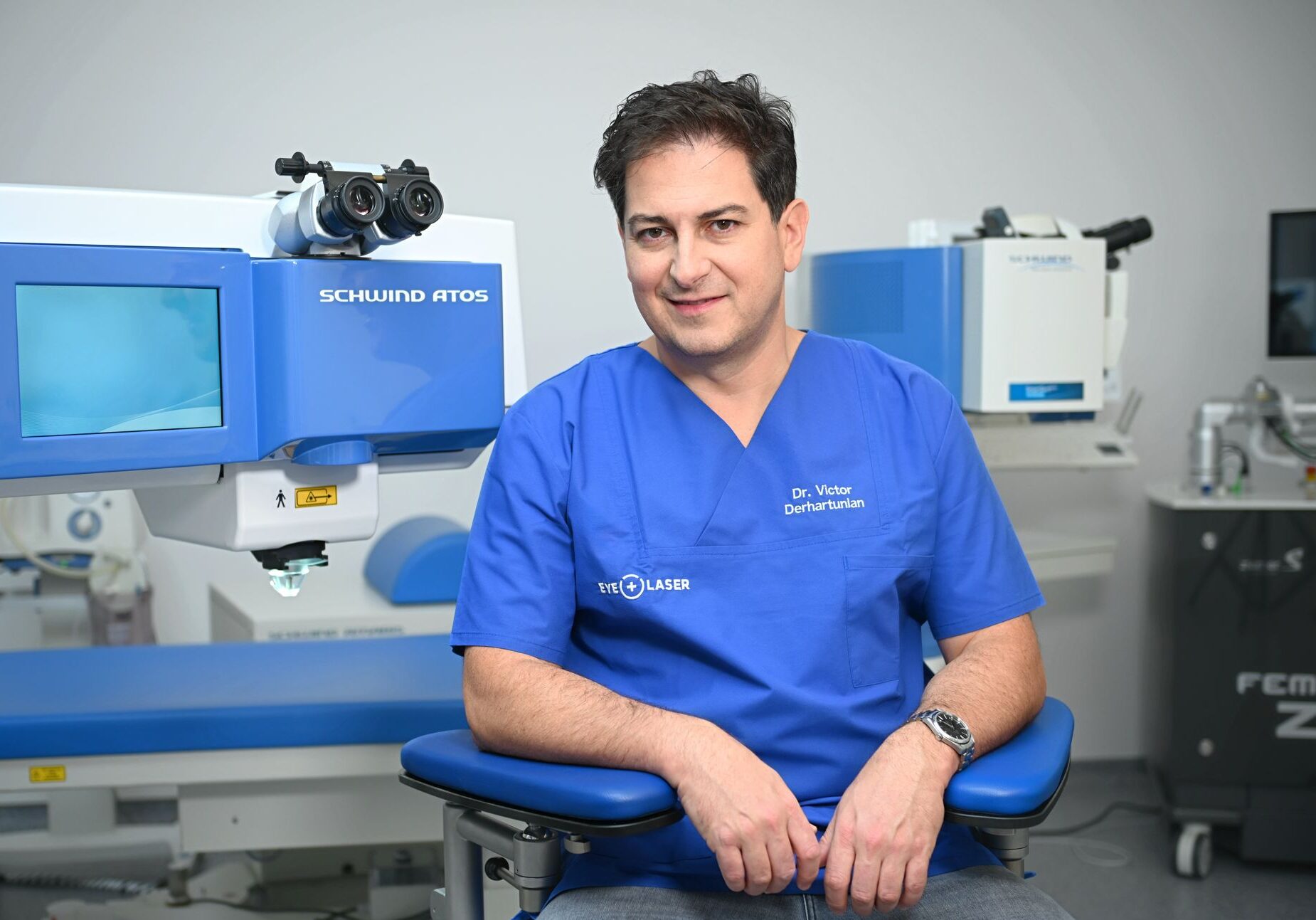
Dr. Victor Derhartunian in blue scrubs in front of the SCHWIND ATOS laser

“Lens surgery is the absolute high-end class of ophthalmology. The fascinating thing about EVO ICL is the freedom of choice: we don’t alter the nature of your eye, we just add an optical masterpiece – and we can reverse it at any time. With lens exchange, however, excellent medicine also requires the courage to say ‘no’. We do not subject myopic patients to the high retinal risk of a lens exchange. We only operate if your eye parameters are absolutely perfect. Your long-term safety is my highest priority.”
– Dr. med. univ. Victor Derhartunian, FEBO, FWCRS

Your Premium Solution for Boundless Vision.

Free yourself from high diopters or presbyopia. Don’t leave your eyesight to chance. Invest in the highest retinal safety, biocompatible premium implants, and the surgical expertise of Dr. Derhartunian.

100% non-binding. No hidden costs. Practice in a prime location in the heart of Vienna.

Frequently Asked Questions (FAQ) about Lens Implantation in Vienna

What is the difference between EVO ICL and a lens exchange (RLE)?

With EVO ICL (often for patients under 45), your natural lens remains in the eye; we place a wafer-thin artificial lens in front of it. With lens exchange (mostly for patients over 50), your own aging lens is removed and replaced with an artificial premium lens (EDOF or trifocal).

Why is lens exchange dangerous for short-sighted people over 45?

Myopic eyes are anatomically longer. If the voluminous natural lens is replaced by a very flat artificial lens during lens exchange, the vitreous humor shifts. This creates mechanical tension on the retina. The risk of dangerous retinal detachment (ablatio retinae) increases drastically. Therefore, for safety reasons, we generally do not perform RLE on myopic patients.

Is lens implantation painful?

No. Your eyes are locally anesthetized with drops. During the surgery (which only takes 10 to 15 minutes per eye), you will only feel slight pressure, but no pain whatsoever.

Premium safety tolerates no haste. The exact optical measurement (IOL-Master), the measurement of the anterior chamber depth (MS39), the endothelial cell count, and the retinal check with dilated pupils require time. In addition, there is the detailed medical consultation.

Absolutely not. The lenses are positioned with micrometer precision inside the eye. There are no pain nerves there. Unlike a normal contact lens, you will not feel the implants when blinking or rubbing.

What material is the EVO ICL made of?

From “Collamer”, a highly developed material made of collagen and polymer. It is 100% biocompatible. Thanks to its “anti-deposit” property, no protein deposits form on it. The immune system does not recognize it as a foreign body, which is why there is never a rejection reaction.

Can the EVO ICL slip?

No. The lens is anatomically perfectly positioned behind the iris and in front of your own lens. It sits there absolutely securely and stably – even during extreme physical activities (combat sports, bungee jumping).

Will implants cause me to have dry eyes?

No. This is the biggest advantage of EVO ICL over laser eye surgery (like LASIK). Since no corneal nerves are severed, the control of your tear film remains completely intact. ICL implants are the best option for patients suffering from dry eyes.

How long does an implanted lens last?

Both the EVO ICL and the lenses used in lens exchange are designed to remain in the eye for a lifetime. The material does not age or cloud.

Why is ICL reversible, but lens exchange is not?

With ICL, we only add a lens without destroying your anatomy. It can be removed at any time in minutes. With lens exchange, we remove your own lens. This is a permanent, irreversible process.

What are "halos" and "starbursts" after a lens exchange?

Multifocal lenses refract light in different rings. At night, scattered light can occur at these rings (halos around car headlights). The brain learns through “neuroadaptation” in the first 3 to 6 months to filter out these effects. With EDOF lenses, this risk is extremely minimized.

When will my vision be sharp after the surgery?

Visual recovery is extremely fast. Most patients see excellently on the first day after surgery. However, with multifocal lenses in lens exchange, the brain still needs a few weeks to perfectly adapt to the new, stepless optics.

When can I return to work after lens surgery?

Office work, including screen work, is usually possible again after about 3 days.

How long do I have to wait to exercise?

Light sports (jogging, exercise bike) are allowed again after 3-4 days. Swimming (Alte Donau, thermal baths) and sauna are strictly forbidden for 3 weeks to avoid severe bacterial infections inside the eye (endophthalmitis). You should avoid combat sports for about 4 weeks.

What is a secondary cataract and how is it treated?

A posterior capsule opacification only occurs with lens exchange. Months or years after the operation, the natural lens capsule can become cloudy. Vision becomes milky. We “polish” this capsule painlessly in the office with a YAG laser in 60 seconds. After that, vision is crystal clear forever.

Am I allowed to drive myself after the surgery?

Absolutely not on the day of the surgery. At the medical check-up the following day, Dr. Derhartunian will give you consent as soon as the legal visual acuity is reached.

Why can't I use face cream or make-up on the day of the surgery?

Makeup particles and cream vapors endanger the microbiological sterility in the operating room. Please come with a freshly washed, completely makeup-free face.

Can I wear make-up after the procedure?

Please completely refrain from eye make-up for at least 1 week to prevent infections from bacteria in mascara or eyeshadow.

Why can't I wear contact lenses before the preliminary examination?

Contact lenses deform the cornea and affect the biometric measurements for the artificial lens. Please remove soft lenses 1 week and hard lenses 4 weeks before the examination.

Are both eyes operated on the same day?

With the ICL, we often operate on both eyes on the same day. With lens exchange, both eyes are usually operated on in the same session, each as a separate procedure with its own instruments. On request, we operate on them on separate days.

Can I get a lens despite severe astigmatism?

Yes, absolutely. Both the EVO ICL and premium replacement lenses are available as “toric” versions. These are precisely adapted to the axis of your astigmatism.

What happens if a toric lens rotates in the eye?

A toric lens must sit in the calculated axis. Rarely, it rotates slightly in the first weeks, and vision becomes less sharp again. That is why we check the axis position at every follow-up. If the lens has rotated, we realign it in a short procedure.

Why does the preliminary examination at EyeLaser take almost two hours?

Premium safety allows no rushing. Precise optical biometry (IOL Master), measurement of anterior chamber depth (MS39), endothelial cell count, and retinal examination with dilated pupils all take time. Added to this is the detailed medical consultation and informed-consent discussion.

What are the costs for lens implants in Vienna?

Lens implants are the high-end class of surgery. An EVO ICL or a lens exchange with premium lenses (EDOF/trifocal) often costs between 3,000 and 4,500 Euros per eye. The price reflects the extremely high material costs of the Swiss or US implants (Collamer).

Does the Austrian health insurance fund (ÖGK) cover the costs?

No. Health insurance only covers a standard lens for already advanced cataracts. Implantation for glasses-free vision is considered a private service. However, you can claim the costs as “extraordinary expenses” in your employee tax assessment.

Do you offer installment payments?

Yes, in cooperation with our reliable financing partners, we offer convenient installment payments.

Can I still have cataract surgery later after an ICL procedure?

Yes, absolutely without problems. Should you develop cataracts in old age (e.g., at 75), the EVO ICL will be removed in a few minutes, and a normal cataract operation (lens exchange) will be performed. The ICL absolutely does not block any medical paths for you in the future.

What happens during follow-up checks?

Our follow-up schedule is strict: 1 day after surgery, 1 week after surgery (extremely important for checking intraocular pressure and lens position), 1 month after surgery, and an annual check-up. We provide continuous support.

Is a femtosecond laser (FLACS) used in lens exchange?

No. We remove the natural lens with ultrasound (phacoemulsification) through an incision of 2.2 to 2.4 mm. According to the recommendations of the European Society of Cataract and Refractive Surgeons (ESCRS), laser-assisted surgery (FLACS) is equivalent to the manual technique and does not measurably improve the visual acuity achieved. We therefore do not offer it, and there is no femtosecond laser surcharge.

Is lens implantation the same as lens exchange?

No. Lens implantation is the umbrella term for two procedures. With the ICL, an additional lens is placed in front of your own; your own lens stays and the ICL can be removed again. With lens exchange, your own lens is replaced by an artificial lens, which is permanent. Which option suits you depends mainly on your age, your refractive error and the condition of your own lens.

What is an implantable contact lens?

This is a common name for the ICL: a thin lens made of Collamer that sits behind the iris in front of your own lens. Unlike a contact lens, you cannot feel it and it needs no care. It stays in the eye permanently but can be removed if needed.

Laser eye surgery or a lens: which is better?

If the cornea is healthy and your values are within the laser range, a laser procedure is usually the first choice because no surgery inside the eye is needed. A lens is an option for very high refractive errors, a cornea that is too thin or irregular, dry eyes or, from about 55, if presbyopia is to be treated as well. The pre-operative examination shows which option suits your eyes.

Honestly asked

What if …? The most common worries before lens implantation

Almost everyone who comes to us has the same questions in mind and does not always dare to ask them. Here are the honest answers.

“Does it hurt?”

No. The eye is numbed with drops, with light sedation on request. You feel pressure and light, no pain. The procedure takes about 10 to 15 minutes per eye; afterwards a foreign-body sensation for a few hours.

“Will I feel the lens in my eye?”

No. The ICL sits behind the iris, in front of your own lens, and floats in the aqueous humour. It is invisible from outside, needs no care and is not felt, unlike a contact lens.

“What if my eye changes?”

The ICL is reversible: it can be removed or exchanged for a different power. If a cataract develops decades later, it is simply taken out during the lens exchange. Nothing about your eye is permanently altered.

“Could I go blind?”

The lens is inserted through a 2 to 3 mm opening; retina and optic nerve are not touched. The relevant risks are an infection (very rare; sterile theatre, antibiotic drops, check-up the next day) and a rise in eye pressure, which we measure on the day of surgery and at the check-ups. That is why the ICL comes with a yearly check-up, permanently.

“What if the result isn’t right?”

We only implant lenses whose power and size we have measured on your eye beforehand (anterior chamber depth, endothelial cells, axial length). Residual refractive error is rare; it can be corrected by exchanging the lens for a different power or a small laser touch-up. We do not guarantee a medical result, but we stand by it.

“I don’t dare to make a decision.”

You don’t have to today. The first step is a preliminary examination with the chief surgeon, without obligation. Only the measurements show whether the ICL is the right path for you at all. After that you have as much time to think as you need. Nobody at our clinic is pushed into an appointment.

We answer further questions in the FAQ below or in person at the suitability check.

What patients say

Reviews

4.9 out of 5 from 244 Google reviewsAll reviews on Google →Patient stories with video →

“I was looked after excellently and kindly by the EyeLaser team and decided on ICL lens surgery as a result. You are given all the information you need for the operation and for the time afterwards.”

Thomas M. · Google review (translated from German), July 2026

“From the very first moment I felt in the best hands with Dr. Derhartunian. The whole team is incredibly friendly, well organised and really takes time for every patient.”

Ralf P. · Google review (translated from German), July 2026
Read on

What comes next?

Lens implantation and laser eye surgery solve the same problem in different ways. The comparison:

4,9 von 5 – über 240 Google-Bewertungen für EyeLaser Wien & Linz