

Eye Drops Instead of Glasses? Drops for Presbyopia vs. PresbyLASIK, Allotex TransForm™ and Lens Replacement – A Method Comparison
We’ve all been there: you’re standing in the store, trying to read the ingredients on a yogurt pot and the letters blur before your eyes. You hold the product further and further away from your face until you stretch your arm out like a giraffe stretching its neck to grab leaves from a tall tree. This is presbyopia – the presbyopia that sooner or later knocks on the door of every one of us after the age of forty.
The right solutions? These are mainly surgical procedures: PresbyLASIK, Allotex TransForm™ and lens replacement, which we have mastered perfectly at the EyeLaser Clinic. But there is now also an interesting alternative – the VIZZ (aceclidine) and Vuity (pilocarpine) drops. The FDA has just given the green light for VIZZ and the manufacturer promises that they will be on the market in America this year.
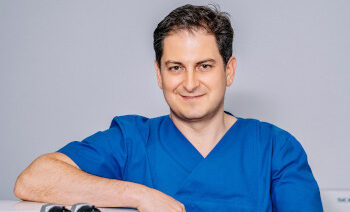
The question is: Are the drops a real revolution or rather a plaster on a deeper wound? Dr. Victor Derhartunian, who has treated hundreds of patients suffering from presbyopia in his career, explains why surgery will remain the way to go in this area.
Auf dieser Seite8 Abschnitte
- What exciting insights are there?
- How do drops work against presbyopia?
- Modern Surgical Methods – The Right Solutions for Presbyopia
- Are Eye Drops for Presbyopia Really the Cheaper Solution?
- When Should You Choose Drops and When Go Under the Knife?
- Dr. Derhartunian Shares His Experience
- In short…
- Frequently asked questions (FAQ)
What exciting insights are there?
- Will the new VIZZ drops really revolutionize the eyewear market? The effect only lasts a few hours, so it’s more of a temporary patch than a real solution.
- Which methods provide a permanent cure for presbyopia? PresbyLASIK, Allotex TransForm™ and lens replacement are proven techniques that provide a lasting solution to the problem.
- Why does surgery beat drops in the long run? Once done, it lasts for years – plus it comprehensively corrects vision and saves money in the long term.
- How do you choose the best method for you? It depends on your lifestyle, the degree of presbyopia and other visual defects – at EyeLaser Vienna we fit the treatment like a tailor-made suit.
- Are the latest technologies available to Austrian patients? In our clinic we have a wide range of the most modern methods for vision correction.
How do drops work against presbyopia?
The mechanism? The drops constrict the pupil (in medicine we say “miosis”), which creates a pinhole effect. It’s like looking through a keyhole – everything up close appears sharper because the depth of field increases.
VIZZ (Aceclidine)
- Precisely targets the pupil sphincter muscle and bypasses the ciliary muscle
- Does not impair distance vision (a major advantage!)
- Works for up to 10 hours – you don’t have to carry a dropper bottle in your pocket
- Packaged in sterile single-use ampoules
- Reversible – can be used anew every day.
Vuity (Pilocarpine)
- Attacks both muscles simultaneously – the pupil sphincter muscle and the ciliary muscle
- Can cause temporary myopia and dizziness
- Lasts about 6 hours – shorter duration of action than VIZZ
- Reversible – can be used anew every day.
VIZZ Studies
VIZZ underwent a series of clinical studies with 466 volunteers. The CLARITY studies showed that:
- The effect starts after just half an hour
- It lasts 10 hours
- The correction is repeatable from day to day
Most patients reported mild side effects. Most common: mild irritation, blurred vision and occasional headaches.
Advantages and Disadvantages of Drops
Compelling advantages:
- Lightning-fast start – the effect is quickly noticeable
- No scalpel – no pre- or post-operative stress
- You can always stop by simply not taking them anymore
Limitations:
- The effect only lasts hours and they must be taken daily
- Side effects can be annoying – blurred vision at night, sometimes headaches
- Only presbyopia is corrected, other visual defects remain untouched
- Presbyopia progresses anyway – drops are symptom management, not a solution to the problem
- Cost – annually it can cost as much as a nice vacation
Modern Surgical Methods – The Right Solutions for Presbyopia
Now it gets exciting! Unlike drops, which are like renting an apartment, surgery is buying your own house. At EyeLaser Vienna we are experts in the most modern methods of vision correction.
1. PresbyLASIK – Multifocal Vision Profile with the Laser
How does it work? The laser precisely reshapes the cornea and creates a multifocal vision profile.
Advantages that bring joy:
- Once done, it corrects for decades – a long-term investment
- “All inclusive” package – presbyopia plus correction of other visual defects in one go
- Quick return to everyday life – normally you’re back in action the next day
- Proven technology – thousands of satisfied patients worldwide
- Economically profitable – you pay once, don’t buy every month
Disadvantages? Few:
- The cornea must be in good condition and sufficiently thick
- The brain needs time to adjust (2-6 months)
- Temporary dry eyes in some patients
2. Allotex TransForm™ – The Bio-Lens from the Future
How does Allotex TransForm™ work? The implantation of an ultra-thin bio-lens made from human cornea into your cornea. Sounds futuristic? It is!
Strengths:
- Reversible – can be removed if needed
- 100% natural material – your body accepts it well
- The anatomy remains untouched – no radical changes
- One-eye strategy – often it’s enough to correct just one eye
At the EyeLaser Clinic we are experts in this innovative method!
Weaknesses:
- Long-term effects – we are still collecting data
- Adjustment phase – can be uncomfortable at first
- Theoretical rejection risk – the body can rarely, but still, react with rejection to the artificial lens
3. Lens Replacement (RLE) – The Method for Best Results
The idea: We remove the natural lens and insert a multifocal or EDOF (Extended Depth of Focus) lens.
Unbeatable advantages:
- Permanent solution – the effect lasts a lifetime
- Universal key – corrects absolutely all visual defects
- Cataracts? Not for you – the artificial lens never becomes cloudy
- Ideal for high visual defects – where the laser reaches its limits
- Wide selection and individual customization – different lens types for different needs
Disadvantages:
- Greater invasiveness – we correct the substance of the eye
- Possible halos at night – depends on the lens type
- Longer recovery phase – several weeks until full recovery
- Higher costs – quality has its price
Comparison Table of Methods
| Method | Duration of Effect | Correction Range | Recovery Time | Invasiveness | Main Side Effects |
|---|---|---|---|---|---|
| Drops (VIZZ/Vuity) | Hours | Only presbyopia | None | Non-invasive | Blurred vision at night, headaches |
| PresbyLASIK | Years | Presbyopia + other visual defects | Few days | Minimal | Dry eyes, temporary glare effects |
| Allotex TransForm™ | Years (reversible) | Presbyopia | Several days – weeks | Minimal | Discomfort, theoretical rejection risk |
| Lens Replacement | Permanent | All visual defects | Weeks | Moderate | Halos, nighttime glare effects |
Are Eye Drops for Presbyopia Really the Cheaper Solution?
Let’s make this an everyday example: Do we prefer to pay for an expensive rental car for a lifetime or buy a car?
Drops are recurring costs without end:
- Annually: approx. $800-1200
- In 10 years: $8000-12000
- In 20 years: $16000-24000 (the price of a new car!)
Surgery is buying property:
- One-time: $3000-8000
- Further costs? Zero (in relation to presbyopia)
- The economics in comparison are clear.
When Should You Choose Drops and When Go Under the Knife?
Drops are suitable when:
- You want to try out the correction before making a decision
- You have contraindications for surgery
- Presbyopia is your only vision problem
- You like unrestricted reversibility – from day to day
- You need occasional, not daily correction
Surgery is unbeatable when:
- You’re looking for a permanent, precise solution
- You have visual defects to correct beyond presbyopia
- You value independence from glasses, contact lenses and drops
- Presbyopia is already severely limiting
- Your lifestyle requires functioning vision all day long
Dr. Derhartunian Shares His Experience
At Eyelaser we observe the future of ophthalmology from the front row.
“Drops are an interesting option”, says Dr. Derhartunian, “but after 20 years of practice I know that patients above all want peace of mind. They want to wake up in the morning and see sharply, without thinking about drops, glasses or the fear that the effect will wear off soon.”
Dr. Derhartunian, who also heads the EyeLaser clinics in Vienna and the Laser Surgery Center in Zurich, adds: “I recently operated on a patient who had been using drops for presbyopia for half a year. He told me: ‘Doctor, this is like dating someone who will never commit. I want the marriage with good vision now!'”
In short…
Drops for presbyopia? A cool invention, no question. But it’s like a battery-powered flashlight in the age of LEDs – it may work when you need it, but in the long run you almost always hope for more than it can deliver.
The real solutions are PresbyLASIK, Allotex TransForm™ and lens replacement. They provide a permanent effect, save money and restore true visual freedom. At Eyelaser we know these methods like the back of our hand and adapt them individually to each patient.
Our experience from thousands of procedures performed? Patients who opted for surgery say one thing: “Too bad I didn’t do this sooner!”
Frequently asked questions (FAQ)
Can You Already Buy VIZZ Drops at Austrian Pharmacies?
No. VIZZ has received the green light from the FDA in the USA and will be available there from the end of 2025. No one has yet spoken of approval in Austria.
Drops or Surgery – Which Is More Expensive?
In the short term, drops seem cheap. But calculated over 10 years, that’s $8000-12000 versus a one-time $3000-8000 for the procedure. The math speaks for surgery.
Are Drops a Complete Solution for Eye Problems?
Unfortunately not. It’s like aspirin for migraines – it provides relief but doesn’t eliminate the cause. The drops only work for presbyopia and only for a few hours. Other visual defects? They continue to persist.
How Do You Choose the Best Surgical Method?
It’s like choosing a car – it depends on your needs. PresbyLASIK is a universal compact car, Allotex TransForm™ is an elegant coupe with modification options and lens replacement is an SUV that overcomes everything. At EyeLaser Vienna we select the method after a detailed analysis.
Can You Trust the Safety of the Procedures?
Absolutely. These are not experiments, but proven methods with a long track record of success. The risk? Minimal, especially in experienced hands. At Eyelaser we have thousands of satisfied patients.
How Much Time Do I Need Until Healing Is Largely Complete?
PresbyLASIK: A few days and you’re ready. Allotex TransForm™: from a few days to a couple of weeks. Lens replacement: several weeks for full recovery. But in any case you return to normal life quickly.
What If It’s Enough to Correct Just One Eye?
A great idea! The monovision strategy works excellently – one eye for distance, the other for near. It works particularly well with Allotex TransForm™. The brain quickly learns to use the right eye for each situation.
What If Vision Changes in the Future?
Don’t worry! Laser procedures and lens replacement provide a permanent effect. Allotex TransForm™ can be removed if needed. And if new problems arise? You can always make a correction or apply a different method.
INFO: Remember: This information is for educational purposes and does not replace a doctor’s visit. Every case is different and requires individual assessment.