Laughing woman covering one eye with her hand

Laser eye surgery permanently corrects short-sightedness, long-sightedness and astigmatism: the laser reshapes the cornea by a few thousandths of a millimetre so that light is focused sharply on the retina again. At EyeLaser Vienna you can choose between three procedures: SmartSight without a flap, Femto-LASIK and Trans-PRK. Which one suits your eyes is decided by the measurements taken at the preliminary examination, not by a catalogue.

The treatment takes about ten minutes per eye, and most patients are back at work after one to three days. Prices are fixed, from €1,700 per eye, including twelve months of aftercare and a re-treatment within twelve months should it become necessary. Surgery is performed at Opernring 1 by Dr. Victor Derhartunian, FEBO, FWCRS; EyeLaser is a reference centre for SCHWIND. On this page you will find the suitability criteria, the comparison of methods, the process, the prices and the most frequently asked questions.

What Vision Defects Can be Corrected?

Smiling older man at an eye examination, the doctor's hand on his shoulder

Laser eye correction is extremely effective for the most common types of refractive errors. At our clinic in Vienna, we successfully treat:

  • Nearsightedness (myopia): up to -10.00 dpt
  • Farsightedness (hyperopia): up to +4.00 dpt
  • Astigmatism (astigmatism): up to 6.00 dpt

The suitability and the choice of the optimal procedure are always determined individually after a comprehensive diagnostic examination.

What is laser eye correction? A simple explanation

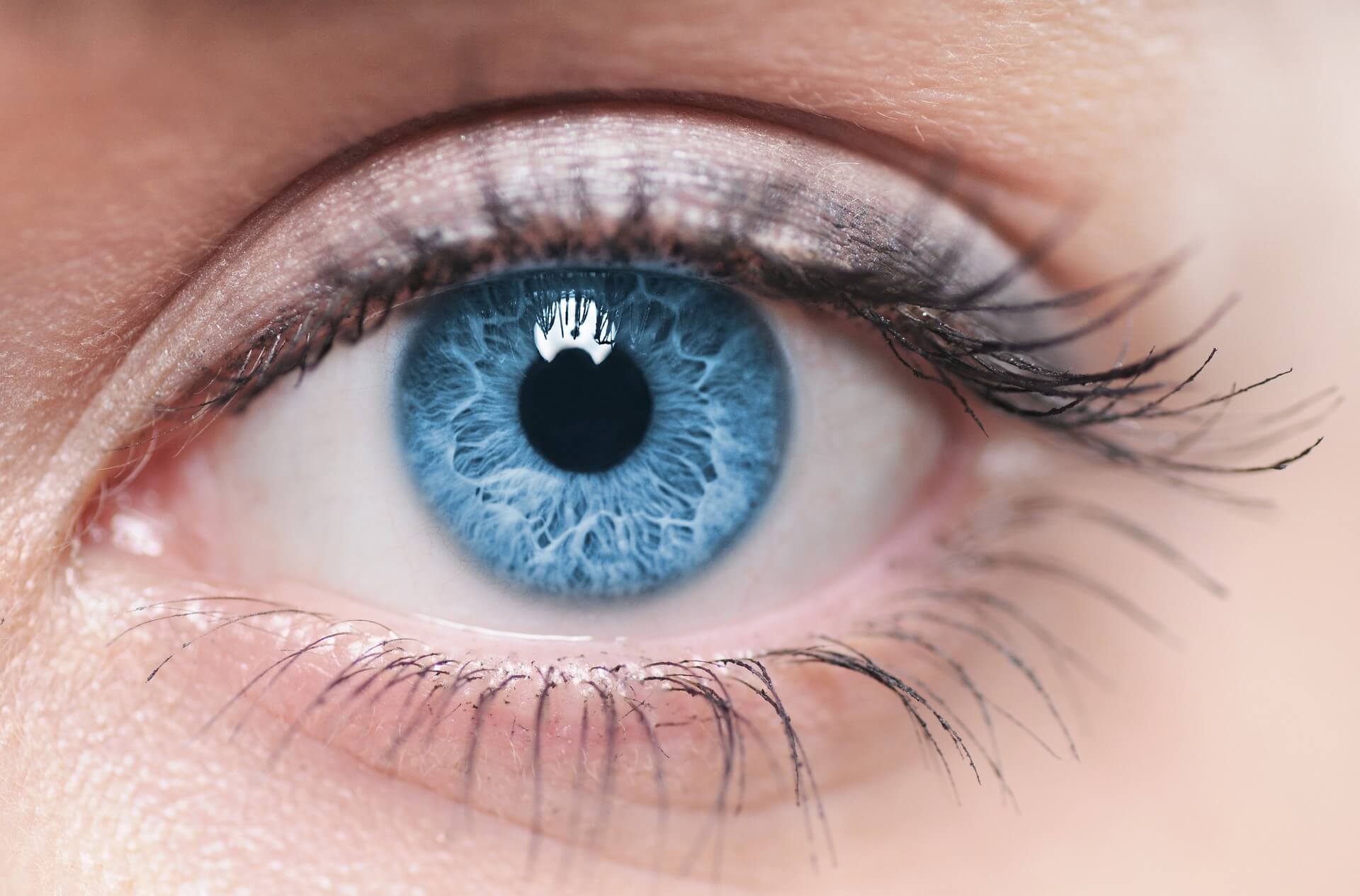
Close-up of a blue eye with long eyelashes

Imagine your eye as a high-quality camera. The cornea is the outermost, clear lens that focuses incoming light so that a sharp image is formed on the retina (the camera’s “film”). In cases of refractive errors like nearsightedness or farsightedness, this focusing is faulty.

The goal of laser eye correction is to precisely and gently reshape the cornea so that light is once again perfectly focused on the retina. The result: a crystal-clear image without corrective devices.

The Technology behind it: Femtosecond and Excimer Lasers

Modern Refractive Surgery Relies on Two Highly Specialized Laser Systems

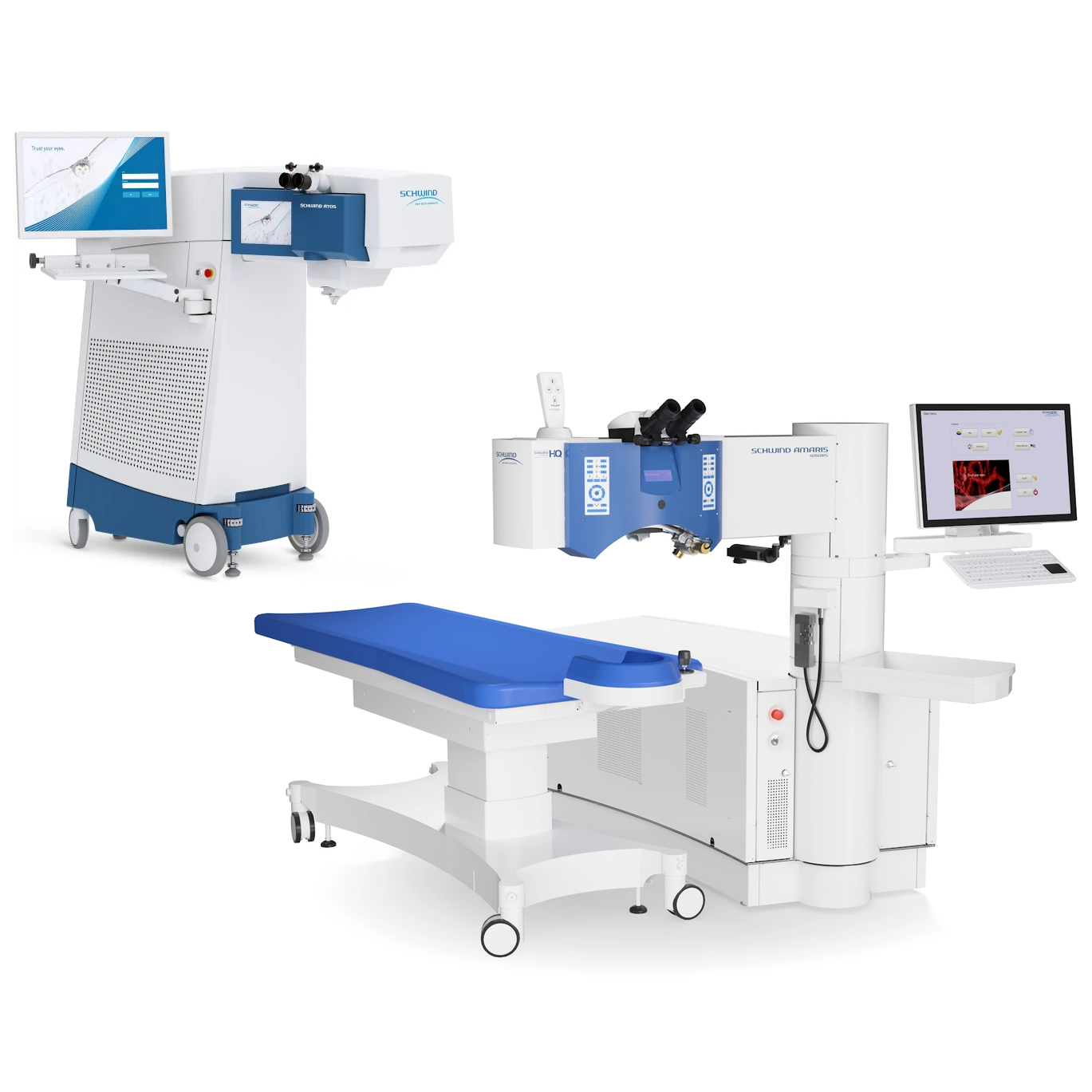
SCHWIND ATOS and SCHWIND AMARIS laser systems with patient bed
  • The Femtosecond Laser: This precision instrument operates with ultrashort light pulses in the femtosecond range. Its task is to prepare the cornea for the actual correction. Depending on the method, it creates a wafer-thin corneal flap (Flap) for the Femto-LASIK procedure or a precise lens-shaped tissue piece (lenticule) inside the cornea for the SmartSight method (Schwind ATOS)
  • The Excimer Laser: It is responsible for the actual vision correction. Using photoablation, it removes microscopically thin layers of corneal tissue. At EyeLaser, we use the SCHWIND AMARIS 7D Laser, which, thanks to its 7-dimensional eye-tracking, compensates for every eye movement in real-time, thus ensuring unparalleled precision.

The Path to Clear Vision: your Treatment Process at EyeLaser Vienna

The Crucial Preparation

Take a break from wearing contact lenses before the preliminary examination:

    • Soft lenses: at least 7 days
    • Hard lenses: at least 4 weeks
The Comprehensive Suitability Test (Approx. 2 Hours)

Using state-of-the-art diagnostics, we create a detailed “map” of your eyes. This includes corneal topography, pachymetry, and aberrometry. Based on this data, our experts decide whether a treatment is safe for you and which method to use.

The Treatment Day (Approx. 15–20 Minutes for both Eyes)

The procedure is short and painless. Your eyes will be numbed with drops. A lid holder prevents blinking. While the laser works for a few seconds per eye, you fixate on a light.

The Time after: Quick Recovery

Recovery is exceptionally fast. Most patients can resume their daily activities the next day. In the first few weeks, you should avoid rubbing your eyes and use the prescribed eye drops diligently.

Why EyeLaser Vienna? Your Benefits in 3 Key Areas.

Close-up of an eye with a patterned iris

You only have two eyes. This is a once-in-a-lifetime decision. Here’s why patients from all over Austria trust us:

  1. Proven world-class expertise: Your surgeon, Dr. Derhartunian, was trained by the pioneers of eye surgery (Prof. Kohnen, Prof. Seiler). As a SCHWIND Key Opinion Leader, he himself trains other doctors. With us, you don’t receive standard treatment, but the expertise of an internationally leading specialist.
  2. Superior technology for maximum safety: We use SmartSight the most modern form of lenticule extraction – gentler and more precise than older SMILE procedures. Our SCHWIND AMARIS & ATOS lasers are among the world’s best. We invest in technology so you can invest in your safety.
  3. The personal care of a boutique clinic: Unlike large, impersonal chains, you will be personally cared for by Dr. Derhartunian and his core team from the first consultation to the final check-up. With us, you are not just a number, but a patient whose goals and concerns we take seriously.

Prices & Methods in Vienna – Transparent and Fair

Comparison: Price per Eye (EUR) · Key Benefits
Method Price per Eye (EUR) Key Benefits
Trans-PRK 7D Standard 1,700 No-touch, incision-free, proven for thin corneas.
Trans-PRK 7D Wavefront 3,000 Wavefront-optimized, for maximum visual quality and contrast.
Femto-LASIK 7D Standard 1,950 The proven classic, usually sharp vision by the next day.
Femto-LASIK 7D Wavefront 3,000 Wavefront-guided ablation profile for night vision and contrast.
SmartSight (flapless) 2,500 Minimally invasive, gentle on the tear film, ideal for active individuals.
ICL/IPCL (phakic lens) 3,500 Reversible, excellent HD optics, even for extreme prescriptions.
Lens exchange / cataract surgery 3,500 Every lens type at the same price, including multifocal or EDOF.

Financing: Flexible installment payments from approx. €33–68/month possible via our partner bank.

Experience Visual Freedom through your Lens or Laser Eye Surgery

In this video, Dr. Victor Derhartunian explains which laser eye treatments are available at EyeLaser Vienna:

Am I suitable? The EyeLaser Traffic Light

Smiling older couple sitting close together on a light-coloured sofa

🟢 Green Light (Ideal Candidates): You are between 18 and 60 years old, your vision has been stable for at least 12 months, and your cornea is healthy and sufficiently thick.

🟡 Yellow Light (Clarification Required): You are prone to dry eyes, your cornea is rather thin, or certain autoimmune diseases are present.

🔴 Red Light (Not suitable – but there are alternatives): Unstable vision, keratoconus, advanced cataracts/glaucoma, pregnancy. Alternative: Implantation of an ICL lens is often an excellent solution.

SmartSight, Femto-LASIK or Trans-PRK: which one suits me?

Watch: what matters in laser eye surgery

Short film (45 seconds): experienced eye surgeons, modern laser technology and proven methods. We present the three methods SmartSight, SmartSurfACE (Trans-PRK) and SmartLASIK (Femto-LASIK) individually below.Video: SCHWIND eye-tech-solutions

All three permanently correct short-sightedness and astigmatism. They differ in how the cornea is reached, how quickly you see sharply again and what they are particularly suited for. Which one suits you is decided by the measurements at the preliminary examination.

SmartSight

No flap, 2 mm access

Suits you if
you play contact sports, tend to have dry eyes or are short-sighted with astigmatism
Sharp vision
usually from day 1 to 3
Not for
long-sightedness
Fixed price
€2,500 per eye · from €48/month

SmartSight in detail →

Femto-LASIK

The classic with a corneal flap

Suits you if
you are short- or long-sighted and want to be back at work the next day
Sharp vision
usually by the next day
Not for
thin corneas, contact sports with a high risk of injury
Fixed price
€1,950 per eye · from €38/month

Femto-LASIK in detail →

Trans-PRK

No incision, no contact

Suits you if
your cornea is thin or maximum stability matters, e.g. for emergency services and martial arts
Sharp vision
after 3 to 5 days, final result after weeks
Not for
the need to be fit for work immediately
Fixed price
€1,700 per eye · from €33/month

Trans-PRK in detail →

Laser treatment not possible? With very high prescriptions or thin corneas the ICL lens is the alternative; from 45 with reading glasses, PresbyMAX or a lens exchange. The wavefront versions of Femto-LASIK and Trans-PRK cost €3,000 per eye; instalments as per the example calculation on the costs page (5.99 % nominal interest, 60 months).

Important Recommendations and Contraindications for Patients

Close-up of a woman's brown eye with long eyelashes
  • Before the Procedure: Strictly observe the contact lens break. Come without makeup on the day of treatment. Arrange for an escort home.
  • After the Procedure: Use the eye drops exactly as prescribed. Do not rub your eyes. Protect your eyes with sunglasses.

Your Ophthalmologist – Dr. Victor Derhartunian

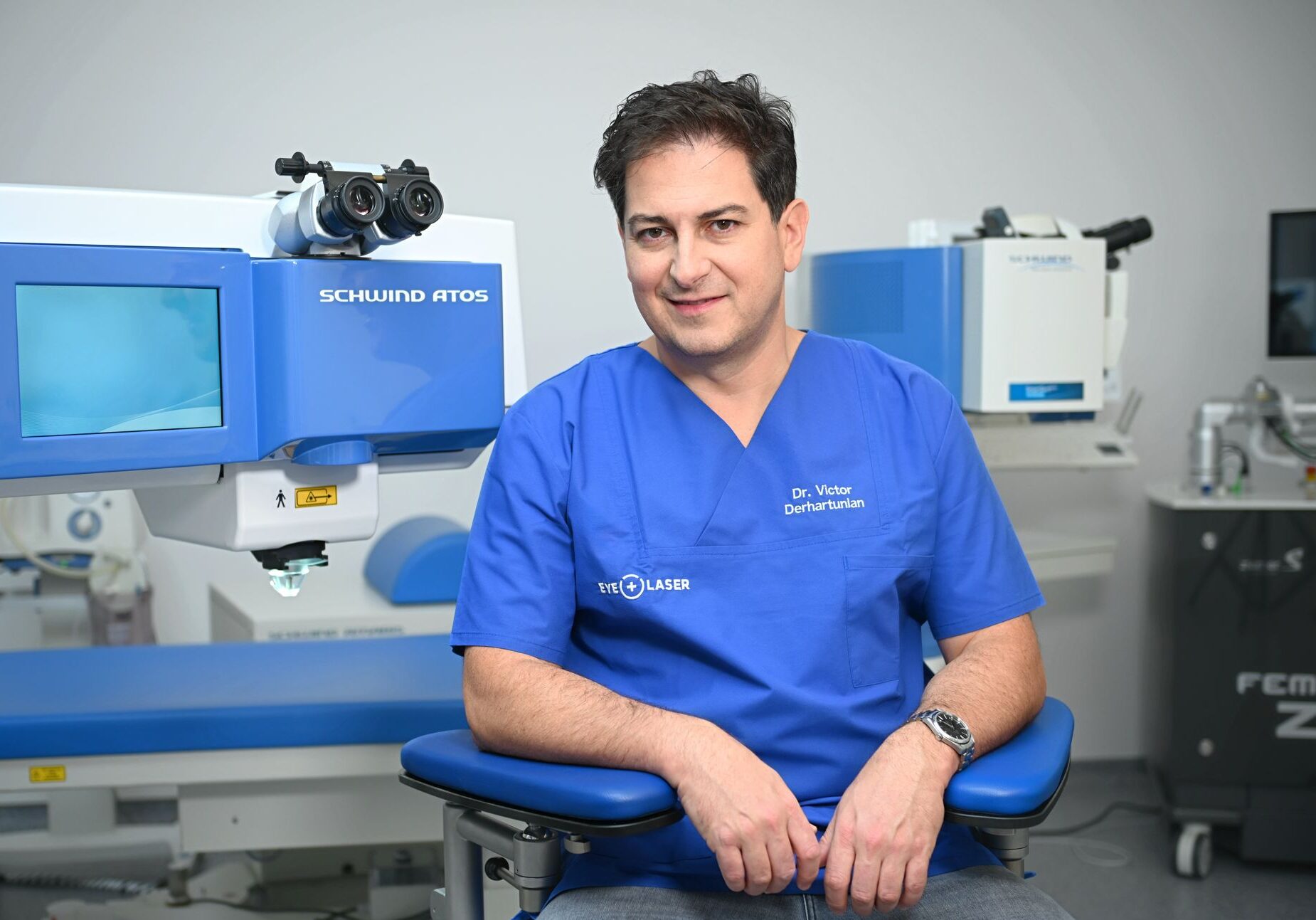
Dr. Victor Derhartunian in blue scrubs in front of the SCHWIND ATOS laser

At EyeLaser, you are not investing in anonymous treatment, but in the expertise and personal care of an internationally recognized specialist.

  • Your Surgeon: Dr. Victor Derhartunian, Specialist in Ophthalmology, FEBO, FWCRS.
  • Training with the pioneers: He learned directly from the masters of his field – refractive training with Prof. Thomas Kohnen (University of Frankfurt) and further education with Prof. Theo Seiler (IROC Zurich), the co-inventor of modern laser eye surgery.
  • International Recognition: Over 25,000 procedures, a role as Key Opinion Leader and reference center for SCHWIND as well as regular lectures at the most important congresses (ESCRS, AECOS, DOG) confirm his leading position.
  • Personal Care in Vienna: Unlike large chains, you will be personally cared for throughout by Dr. Derhartunian or his core Vienna team. You know from the start who is responsible for your eyes.

Location & Contact in the Heart of Vienna

  • Address: Opernring 1, 1010 Vienna. You will find us in one of the city’s most prestigious buildings, directly opposite the Vienna State Opera.
  • Public Transport Access: Perfectly connected. The subway station Karlsplatz/Oper (Lines U1, U2, U4) is just a few steps away. Also from Stephansplatz (U1, U3) you can easily reach us on foot.
  • Parking: Use the surrounding underground car parks such as the Kärntner Straße Underground Car Park or the Opernringhof Car Park.
  • Opening Hours: Mon–Fri 8:00 AM–6:00 PM
Book your appointment in Vienna now

Frequently Asked Questions (FAQ) – Everything You Need to Know about Eye Laser Surgery in Vienna

What Modern and Safe Methods are Available for Vision Correction?

EyeLaser in Vienna exclusively offers the most modern and gentle procedures, including the minimally invasive SmartSight method, the gold standard Femto-LASIK 7D, and lens implants for special requirements.

Am I a Candidate for Laser Eye Correction?

Ideal candidates are between 18 and 60 years old, have had stable vision for at least one year, and have healthy eyes without conditions such as cataracts or glaucoma.

Is the Treatment Painful and how Long Does Recovery Take?

Thanks to anesthetic eye drops, the procedure itself is completely painless, and the most modern procedures allow for very rapid recovery, often within 24 to 48 hours.

Are the Results of Eye Laser Treatment Permanent?

Yes, the corneal correction achieved by the laser is permanent; however, the natural aging process of the eye, such as presbyopia (age-related farsightedness), continues to progress.

What are the Risks and how are They Minimized?

At EyeLaser, risks are reduced to an absolute minimum through an extremely thorough preliminary examination and the use of state-of-the-art 7D tracking technology, with temporary dry eyes being the most common side effect.

What are the Costs for Eye Laser Treatment in Vienna?

The costs depend on the chosen method. At EyeLaser, we rely on transparent pricing. You will learn the exact amount during the non-binding preliminary examination.

When Can I Return to Work and Drive after the Procedure?

With SmartSight and Femto-LASIK, most patients can return to work and drive the very next day. With Trans-PRK, it usually takes 3–5 days.

Will I Still Need Reading Glasses when I get Older?

Yes, laser treatment does not stop natural age-related farsightedness (presbyopia). However, for patients aged approximately 45 and older, we offer permanent solutions for this as well, with PresbyMAX or lens replacement.

Is the procedure really painless? The thought of eye surgery worries me.

We completely understand your concern, but we can reassure you. Thanks to special anesthetic eye drops, the treatment is completely painless. Our patients describe at most a slight pressure sensation during the procedure. Our experienced team in Vienna will also empathetically guide you through the entire procedure, explaining each step and ensuring a relaxed atmosphere. The focus is on ensuring you feel safe and well-cared for at all times.

What Happens if I Blink or Move My Eye During Laser Treatment?

This is one of the most common and important questions. You can’t do anything wrong! Firstly, your eyelid is held open with a small, gentle lid speculum, which prevents blinking. Secondly – and this is crucial for your safety – our state-of-the-art SCHWIND AMARIS 7D laser monitors your eye 1050 times per second in seven dimensions. Even the smallest, involuntary movement is immediately registered and compensated for by the laser in real-time. Should the movement be too large, the laser stops instantly and only resumes when the eye is perfectly positioned again.

Is the Result Permanent or Will I Need Glasses Again in 10 Years?

The result of correcting your refractive error (nearsightedness, farsightedness, astigmatism) is permanent for the rest of your life. The shape of your cornea is permanently altered. Regardless, every eye undergoes a natural aging process. This means that from approximately 40-45 years of age, presbyopia (age-related farsightedness) sets in, making near vision difficult. This is not a return of your old refractive error, but a normal process that also affects people without vision problems.

How Soon after the Procedure Can I Return to Work, E.G., on the Computer?

The recovery time is remarkably short. With our preferred methods, SmartSight and Femto-LASIK 7D, vision is usually good enough the very next day to work on a screen without problems. We recommend resting your eyes a bit on the first day and regularly using moisturizing eye drops to keep your eyes fresh. For a surface treatment like Trans-PRK, it takes about 3-5 days until visual acuity is sufficient for computer work.

Does Laser Treatment Affect Future Eye Examinations or Treatments Such as Cataract Surgery?

No, laser treatment does not pose an obstacle to future medical procedures. The correction only takes place on the outermost layer of the eye, the cornea. All internal structures remain untouched. You can and should continue to undergo regular check-ups. Should cataract surgery become necessary in old age, this is easily possible. It is only important to inform the operating surgeon that laser treatment has taken place so that this can be considered when calculating the new artificial lens.

Will I Need to Use Eye Drops Forever after the Surgery?

No, absolutely not. In the first weeks and months after the procedure, the use of eye drops is an important part of the healing process. You will receive a precise plan from us detailing which drops (antibiotic and moisturizing) you should use and for how long. The sensation of dry eyes is a normal and temporary side effect that usually resolves completely within 3 to 6 months. After that, eye drops are usually no longer necessary.

Does Health Insurance in Austria Cover the Costs of the Treatment?

Generally, laser eye correction is classified as a cosmetic procedure, and the costs are not covered by statutory health insurance in Austria. However, some private supplementary insurances offer tariffs that cover part of the costs. We recommend clarifying this directly with your insurance provider beforehand. Regardless, many of our patients view the costs as a worthwhile investment in their quality of life, which pays for itself over the years by eliminating expenses for glasses and contact lenses.

What patients say

Reviews

4.9 out of 5 from 244 Google reviewsAll reviews on Google →Patient stories with video →

“From the very first moment I felt in the best hands with Dr. Derhartunian. The whole team is incredibly friendly, well organised and really takes time for every patient.”

Ralf P. · Google review (translated from German), July 2026

“I am very happy that I made this decision. One year after the operation everything is in perfect order. Getting up in the morning and no longer needing glasses is a completely different feeling.”

Oskar · Patient story after laser eye surgery, eyelaser.at

“I was looked after excellently and kindly by the EyeLaser team and decided on ICL lens surgery as a result. You are given all the information you need for the operation and for the time afterwards.”

Thomas M. · Google review (translated from German), July 2026
Read on

What comes next?

Which method suits your eyes is decided by the measurements. Read here how the procedures differ and what the next step is:

4,9 von 5 – über 240 Google-Bewertungen für EyeLaser Wien & Linz