What is the difference between the EVO ICL® and a lens exchange?
With the EVO ICL® (phakic lens), your body’s own eye lens remains completely intact in the eye; we insert an ultra-thin artificial lens in front of it. This preserves your ability to focus seamlessly at near distances (accommodation). With lens exchange (usually for patients from 50), your own aging lens is removed and replaced with an artificial lens.
How safe is the EVO ICL® lens?
It is one of the best-documented implants in modern medicine. The manufacturer STAAR Surgical has been researching for over 30 years. With over 4 million lenses implanted worldwide and more than 500 scientific, peer-reviewed publications, the long-term safety and biocompatibility is undoubtedly proven.
Is the implantation of the EVO ICL® painful?
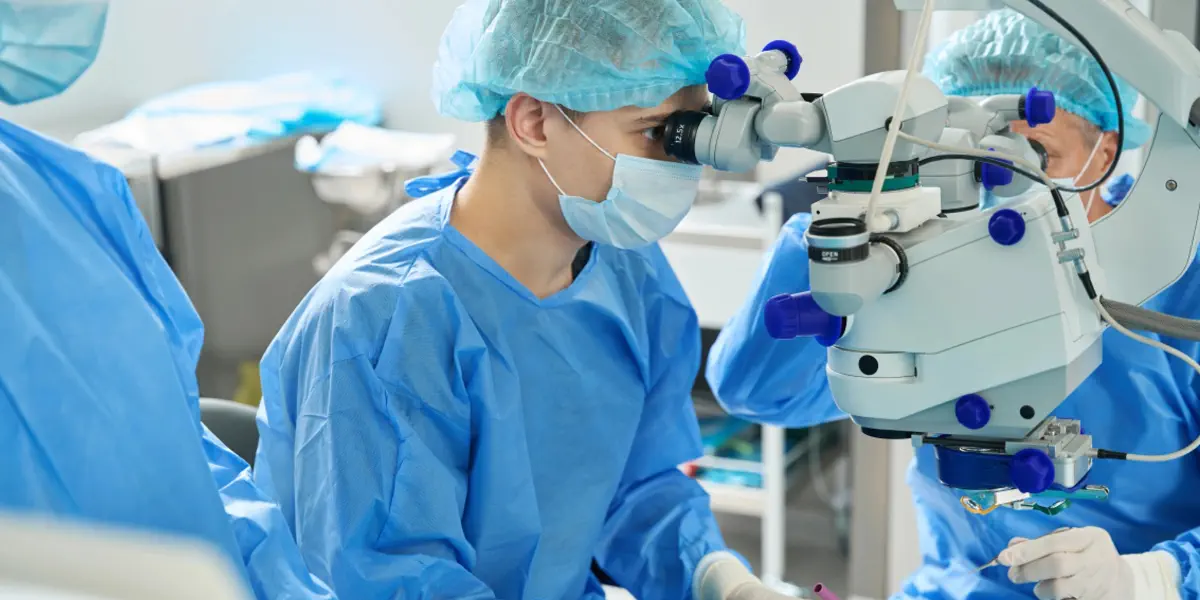
No. Your eyes are completely anesthetized locally with drops. The procedure is absolutely painless. You only feel slight pressure. The operation takes only about 10 to 15 minutes per eye.
Premium safety tolerates no haste. The exact optical measurement (IOL-Master), the measurement of the anterior chamber depth (MS39), the endothelial cell count, and the retinal check with dilated pupils require time. In addition, there is the detailed medical consultation.
Absolutely not. The EVO ICL® is placed inside the eye, behind the iris. There are no pain nerves there. Unlike a soft contact lens that floats on the sensitive corneal surface, you won’t feel the implant when blinking or rubbing.
Can you see the lens from the outside?
No. The EVO ICL® is positioned in the so-called posterior chamber. It is invisible to you in the mirror or to others in everyday life. Only an ophthalmologist can detect it with a slit lamp.
Can the ICL slip in the eye?
No. The lens is anatomically perfectly inserted into the sulcus (the space behind the iris) and fixes itself there stably. Even with extreme athletic stress (martial arts, heading in soccer, bungee jumping), it remains securely in position.
Will I get dry eyes from the ICL?
No, on the contrary. Since no corneal tissue is removed and no corneal nerves are severed, the control of your tear film remains completely intact. The EVO ICL® is the best option for patients suffering from dry eyes.
How long does the ICL lens last in the eye?
The Collamer material does not decompose. The lens is designed to remain in the eye for a lifetime.
Why is the ICL reversible?
Since we don’t remove any body tissue, the architectural structure of your eye remains completely intact. Should your prescription change significantly after 10 or 15 years (or cataracts develop in old age), the ICL can be easily removed or exchanged in a brief procedure. Your eye is then back to its anatomical original state.
When will my vision be sharp after the surgery?
Visual recovery is extremely fast. Most patients see excellently as early as the first day after surgery (the “wow effect”). In the first 24 hours, there may be slight glare sensitivity due to the medicinal dilation of the pupil.
When can I return to work after the procedure?
Most patients are fully able to work again 2 to 3 days after the operation and can also work on screens (PC, smartphone) without problems.
How long do I have to wait to exercise?
Light sports (jogging, cycling) are allowed again after 3-4 days. Swimming (Alte Donau, thermal baths) and sauna are strictly prohibited for 3 weeks to prevent severe bacterial infections inside the eye (endophthalmitis). You should avoid hard martial arts for about 4 weeks.
What are "halos" and "starbursts" after the ICL?
Due to the central Aquaport (the tiny hole in the lens for fluid exchange), some patients may perceive fine light rings (halos) around car headlights at night in the first weeks. The brain learns through “neuroadaptation” to almost completely filter out these effects within a few months.
Am I allowed to drive myself after the surgery?
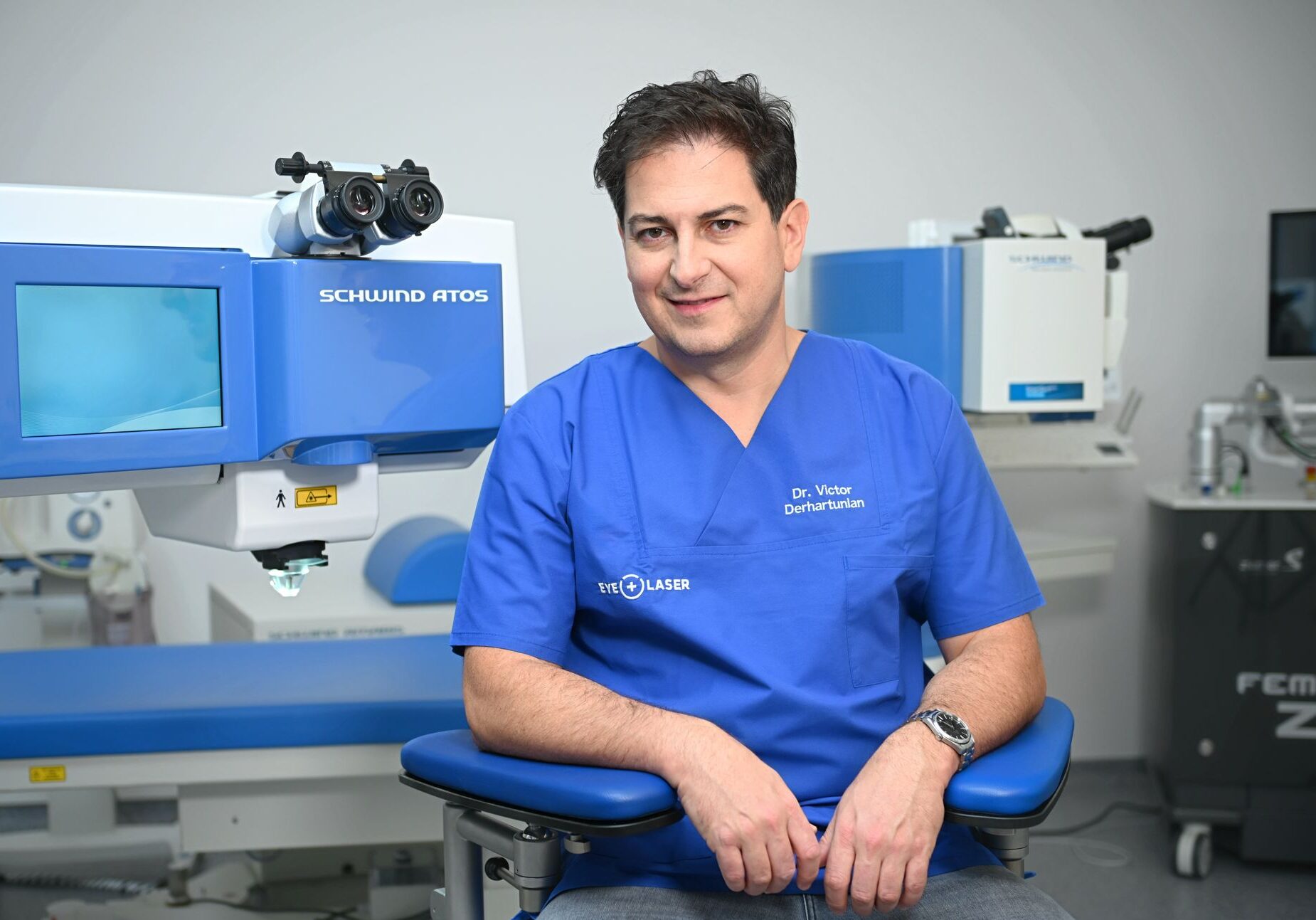
Absolutely not on the day of surgery. At the medical check-up the following day, Dr. Derhartunian checks your visual performance and usually gives you immediate consent to drive.
Why can't I use face cream or make-up on the day of the surgery?
Makeup particles, mascara, and cream vapors massively endanger the microbiological sterility in the operating room. Come to the practice with a freshly washed, completely makeup-free face.
Can I wear make-up after the procedure?
Please refrain completely from eye makeup for at least 1 week to prevent infections from bacteria in cosmetics.
Why can't I wear contact lenses before the preliminary examination?
Contact lenses deform the cornea and influence the biometric measurements (sulcus and anterior chamber depth) that we need to order your ICL accurate to the micrometer. Please leave soft lenses 1 week and hard lenses 4 weeks before the examination.
Are both eyes operated on the same day?
Yes, this is the most common and comfortable approach with the ICL. The procedure is so brief and gentle that we usually treat the right and left eye with the ICL in one session (directly one after the other).
Can I get an ICL despite severe astigmatism?
Yes, absolutely. For this case, we use the “toric EVO ICL®.” This lens is precisely adapted to the axis of your astigmatism and corrects your myopia and astigmatism simultaneously in brilliant sharpness.
What happens if a toric ICL rotates in the eye?
Toric lenses must sit precisely on the calculated axis to the degree. In extremely rare cases, the lens may rotate minimally in the eye in the first weeks. In this case, we simply readjust the lens to the perfect position in a brief, sterile procedure.
I have keratoconus. Is the ICL possible?
If your keratoconus has been successfully stopped and stabilized by UV crosslinking (corneal cross-linking), implantation of an ICL (or a toric ICL) is often the only and best way to free you from strong glasses or hard contact lenses.
Why does the preliminary examination at EyeLaser take almost two hours?
Premium safety tolerates no haste. The precise internal measurement of the eye (sulcus-to-sulcus with MS39), the endothelial cell count, and the retinal examination with dilated pupils (cycloplegia) require time. In addition, there is the detailed transparent medical consultation.
How much does the EVO ICL® cost in Vienna?
The EVO ICL® is the high-end class of reversible surgery. The costs are usually between 3,000 and 4,000 euros per eye. The price reflects the highly precise custom manufacturing and the extremely high material costs of the patented Collamer implant.
Does the Austrian health insurance fund (ÖGK) cover the costs?
No. The implantation of a phakic lens for freedom from glasses is considered a private service (lifestyle procedure). However, you can claim the costs as an “extraordinary burden” for tax purposes in the Austrian employee tax assessment.
Do you offer installment payments?
Yes, in cooperation with our reliable financing partners, we offer convenient, low-interest installment payment models.
Can I still have cataract surgery later in old age after an ICL procedure?
Yes, absolutely without problems. If you develop natural lens clouding (cataracts) in old age (e.g., at 75 years), the EVO ICL is removed in a few minutes. Then a completely normal cataract surgery (lens exchange) is performed. The ICL does not block any medical options for your future.
What happens during follow-up checks?
With ICL lens surgery, our follow-up schedule is extremely precise: 1 day after surgery, 1 week after surgery (extremely important for checking intraocular pressure and the “vault”), 1 month after surgery, and an annual check-up. We accompany you medically without gaps.
Why should I choose EyeLaser Vienna?
Because we don’t take the easy way. We reject patients if the anterior chamber is even a fraction of a millimeter too shallow. We use state-of-the-art 3D sulcus measurements, count your endothelial cells, and guarantee you the personal surgical expertise of Dr. Derhartunian – for a life in uncompromising high-definition.