What are EDOF Lenses – and how Do They Work?

EDOF

EDOF stands for extended depth of focus. Instead of fixed focal points (as with multifocal/trifocal lenses), the optics create a continuous range of focus from distance to the intermediate distance (≈ 60–90 cm).
Advantage: very natural visual impression, calm night vision (potentially fewer halos) and stable PC range – ideal for everyday life, work and driving.

Memory aid (1 image, 1 metaphor): Like a modern autofocus that doesn’t just keep one point in focus, but a range.

Who are EDOF Lenses Ideal for?

EDOF-Linsen

EDOF lenses are particularly suitable if you …

  • use a lot of computer/laptop/tablet,
  • drive a car professionally/privately (also at night) and prioritize contrast/night comfort,
  • lead an active life (sports/outdoor) and want brilliant distance & intermediate vision,
  • are sensitive to glare and want to minimize optical side effects,
  • accept that for very small print at a short distance, fine reading glasses may occasionally be useful.

At Eyelaser Wien, we check your anatomy, visual habits and goals in the preliminary examination – and individually select EDOF vs. (toric) alternatives.

Comparison: EDOF vs. Trifocal vs. Monofocal

Criterion EDOF Trifocal Monofocal (statutory health insurance)
Near good–very good (everyday life, menu, labels); reading glasses may be necessary for very small print very strong
(often complete near vision freedom)
reading glasses required
Intermediate (PC, 60–80 cm) very strong very strong medium
Distance very good very good very good
Halos/glare tendentially
fewer
initially possible, usually decreasing minimal
Visual impression very natural
, wide depth of field
3 defined distances clear at one distance
Freedom from glasses high in everyday life; near-small print may require glasses very high
in all distances
low

EDOF vs. Standard Monofocal (Compact)

Property EDOF (e.g. Vivity, Eyhance) Standard monofocal
Distance vision excellent, brilliant good
Intermediate (PC) excellent, seamless ❌ Workplace glasses required
Near (reading) functionally good; small print may require reading aid ❌ always reading glasses
Night vision/contrast very good, low halo very good, no halos
Visual impression natural, fluid only one sharp area
Freedom from glasses high everyday independence only for distance

Why Eyelaser Wien?

ReLEx SMILE in Wien – Die Methode erklärt, die Zukunft erleben
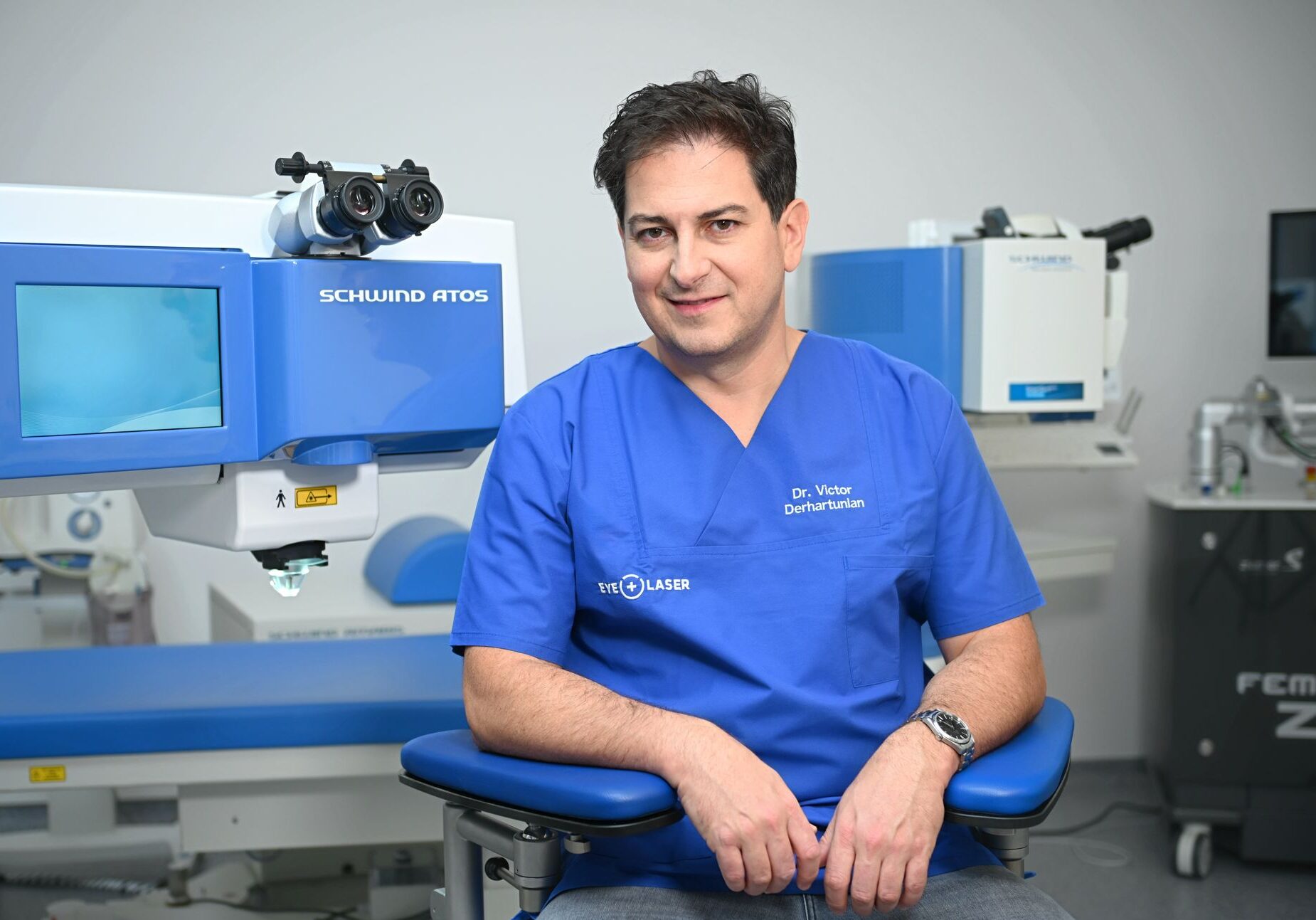
  • Surgeon-led & personal: Consultation, planning and aftercare with Dr. Victor Derhartunian, FEBO, FWRCS.
  • High-end diagnostics: Topography, aberrometry, biometry – basis for tailor-made lens selection (incl. toric EDOF for astigmatism).
  • Transparency & safety: realistic goal definition, clear expectation and side effect management, structured aftercare in Vienna.
  • Central location: Opernring 1, 1010 Vienna – best accessibility by public transport (U1/U2/U4 Karlsplatz, tram on the Ring).

Your Path with EDOF at Eyelaser – in 4 Steps

Consultation & Suitability Check

Anamnesis, vision profile (PC, night driving, sports), wishes

Precision Diagnostics

Exact measurement → decision EDOF vs. alternatives (possibly toric/“blended vision”)

Outpatient Procedure (≈ 15 Min/Eye)

Under drop anesthesia, micro-invasive, structured procedure

Aftercare & Fine-Tuning

Check-ups in Vienna; quick return to everyday life/work, touch-up option for small residual values (depending on cornea/overall findings)

Results & Safety (Safety-Box)

Soczewki Fakijne ICL
  • Fast functional recovery – often significant improvement the following day.
  • Neuroadaptation optimizes contrast & night vision in the first few weeks.
  • Residual values: fine-tuning (e.g. laser touch-up) if required, after conservative indication.
  • Hygiene & standards: structured OP protocols, validated processes, clear emergency contact routes.

Costs & Financing

Kosten
  • Transparent cost plan after diagnostics and lens selection; premium implants must be borne privately.
  • Installment payment possible; we will advise you individually.
  • Statutory health insurance/insurance: refractive motivation = usually no statutory health insurance benefit; in the case of medical indication (e.g. cataract), the respective regulation applies.

A word from Dr. Derhartunian

Dr Victor Derhartunian

“EDOF closes the gap between monofocal and trifocal. Those who prioritize visual quality and night comfort and want to be independent of glasses in everyday life – especially on the PC – often make the best choice with EDOF.”

Testimonials from our Patients

“Relaxed on the screen, clear in the distance – exactly what I was looking for.”

“Pleasantly calm at night, sharp everywhere during the day. I have fine reading glasses for small print – doesn’t bother me.”

Are You Ready for the Decisive Step?

Say goodbye to your reading glasses. The first step is a simple, non-binding suitability analysis in our clinic in Zurich.

Find out whether you can see sharply again with your own eyes.

Yes, I would like a free suitability analysis!

FAQ – EDOF in Vienna (15 Detailed Answers)

Am I Suitable for EDOF?

Often yes, if presbyopia is present and you prioritize intermediate distances (PC, cooking, conversation). We check the cornea, macula, tear film, pupil dynamics and your visual goals. In the case of astigmatism, toric EDOF variants are available. In individual cases (e.g. pronounced maculopathy), we recommend alternatives.

Do I See Completely without Glasses with EDOF?

In everyday life, usually yes (PC, car, shopping, TV). For small print at a short distance – especially in poor light – fine reading glasses may occasionally be useful. We will discuss this clearly in advance.

EDOF or Trifocal – What Suits Me?

EDOF: wide range of focus, tendentially fewer halos, strong in the PC area, very natural impression.
Trifocal: maximum freedom from glasses in all distances including reading small print; halos possible at the beginning, which usually decrease. Decision according to visual habits and priorities.

How Quickly Will I Recover after the Surgery?

Many report the following day of clear, calm vision. In the following weeks, neuroadaptation improves contrast and night vision step by step.

Does the Procedure Hurt?

The operation is performed on an outpatient basis and painlessly under drop anesthesia. Short-term pressure/contact stimuli are possible. The procedure is standardized and will be explained in detail.

Are Halos/Glare Possible with EDOF?

Yes, possible – tendentially less frequent and less pronounced than with classic multifocal designs. We select the lens design to suit your profile and closely monitor the acclimatization.

What is the Vision like on the Screen (Home Office, Office)?

That is a strength of EDOF: the intermediate range (≈ 60–80 cm) is stable and comfortable. Many find laptop/PC vision to be very natural and relaxed.

Can I Do Sports – and from when?

Light activity usually after a few days. Swimming/sauna typically after approx. 2 weeks and medical clearance. Contact/ball sports individually.

How Long Does an EDOF Lens Last?

The lens is designed for lifelong use. Since the natural lens is replaced, cataracts can no longer develop later.

Do I Need Follow-Up Checks – how Do They Work?

Yes. We plan a structured check-up plan (e.g. day 1, week X, month X). If you have any questions, you have direct contact routes to the team in Vienna.

What if Small Residual Values Remain?

Depending on the cornea/overall findings, fine-tunings are possible (e.g. laser touch-up). We plan conservatively and prioritize safety and quality.

Are there Toric EDOF Lenses?

Yes. In the case of astigmatism, toric EDOF implants are available. Selection according to biometry, axis and stability.

Which Manufacturers Do You Use?

We work with premium implants from leading manufacturers and select the design based on your vision profile (near vision, night comfort, screen work). We will discuss the details in the appointment.

Does the Health Insurance Company Cover the Costs?

In the case of refractive motivation, usually no. In the case of medical indication (e.g. cataract), the respective insurance rules apply. We will support you in clarifying this.

How Do I Arrange an Appointment – how Quickly Can I get Started?

Online or by phone. The initial consultation is non-binding and clarifies suitability, goals and the best lens option (EDOF, trifocal, monofocal, toric). Appointments are usually available quickly.